← Lottery Ball Machines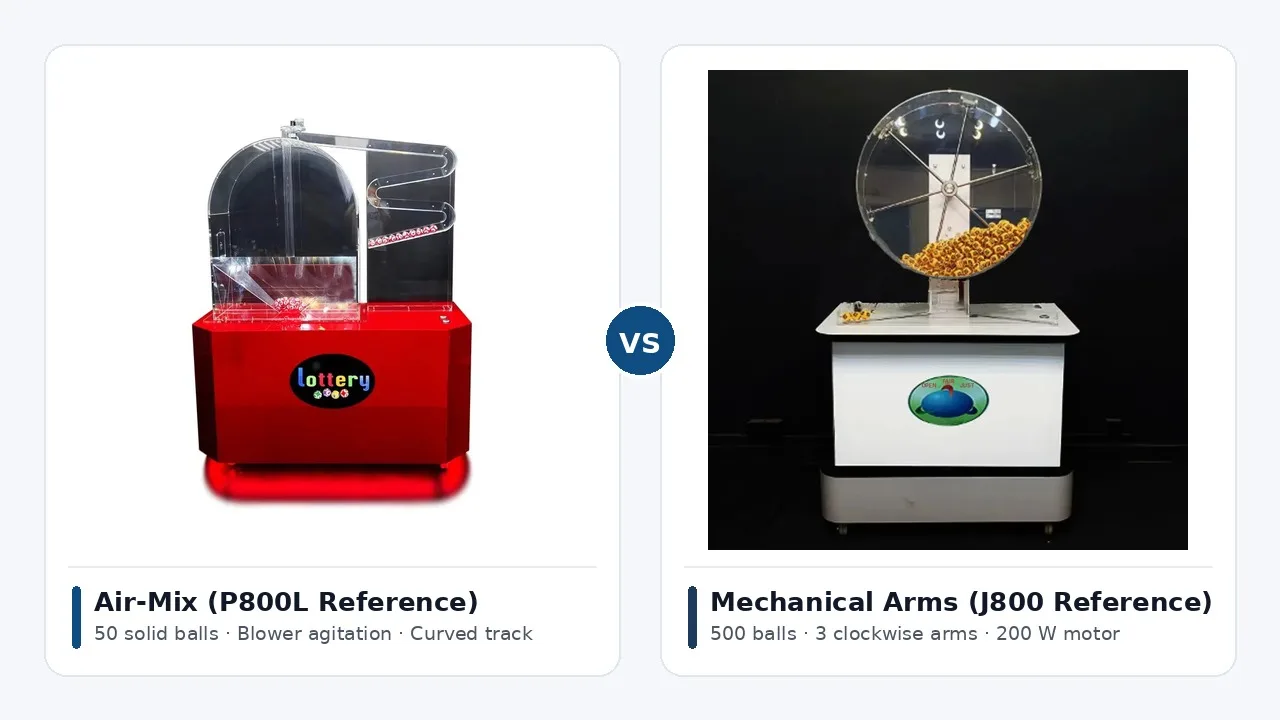
Air-Mix vs Mechanical Lottery Machines: Comparing Capacity, Ball Type, Power and Draw Workflow
Air-mix lottery machines use airflow in transparent chambers for fast 10–200 ball draws and multi-cylinder digit games. Mechanical rotating-arm machines tumble 50 to 2,000 solid or ping-pong balls at lower motor wattage when large single pools and open front viewing matter most.
Written by Jisun Product Team
Choose an air-mix lottery machine when your draw runs 10 to 200 balls, uses independent Pick-2 to Pick-7 digit chambers, or requires fast automatic ball return between rounds. Choose a mechanical rotating-arm machine when you need a single pool of 100 to 2,000 solid or ping-pong balls, lower motor wattage around 200 W, and continuous tumbling visibility without high-velocity blower airflow.
How do air-mix, jet top-ball and mechanical rotating-arm mechanisms actually differ?
Buyers comparing commercial lottery ball machines often group equipment by cabinet shape rather than internal physics. In practice, three distinct agitation paths govern how balls move, how loudly the unit runs and how many balls one chamber can physically circulate:
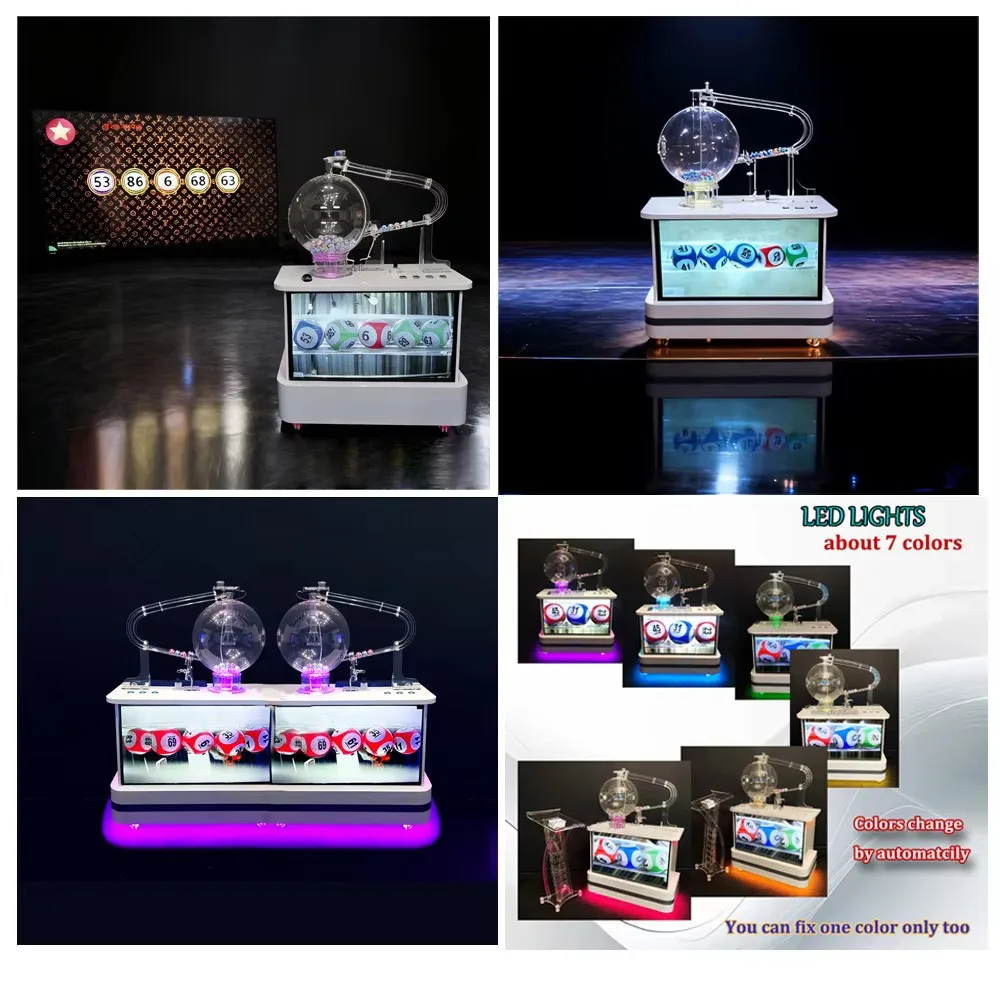
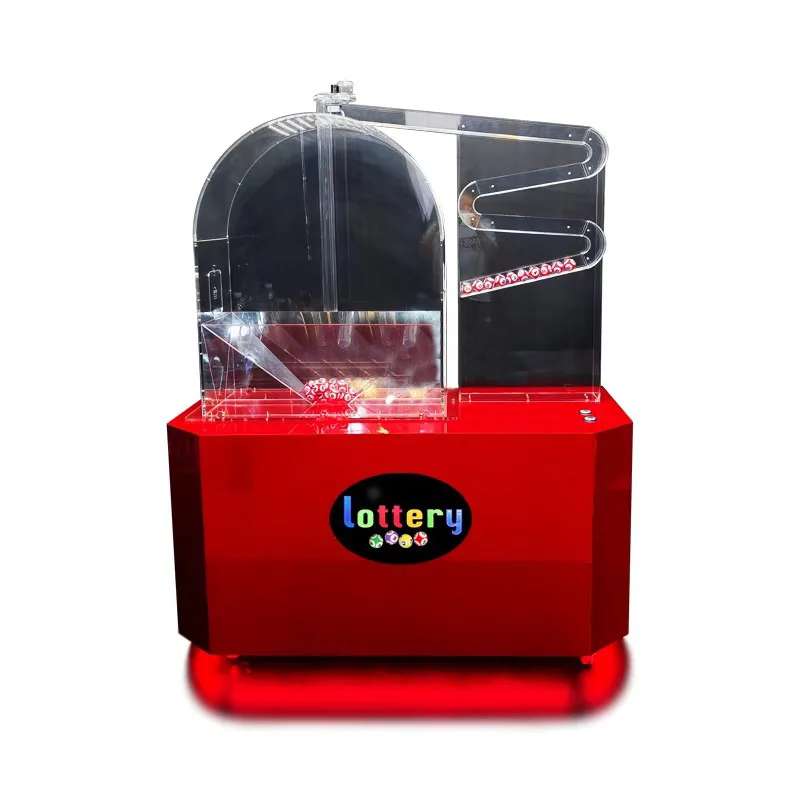
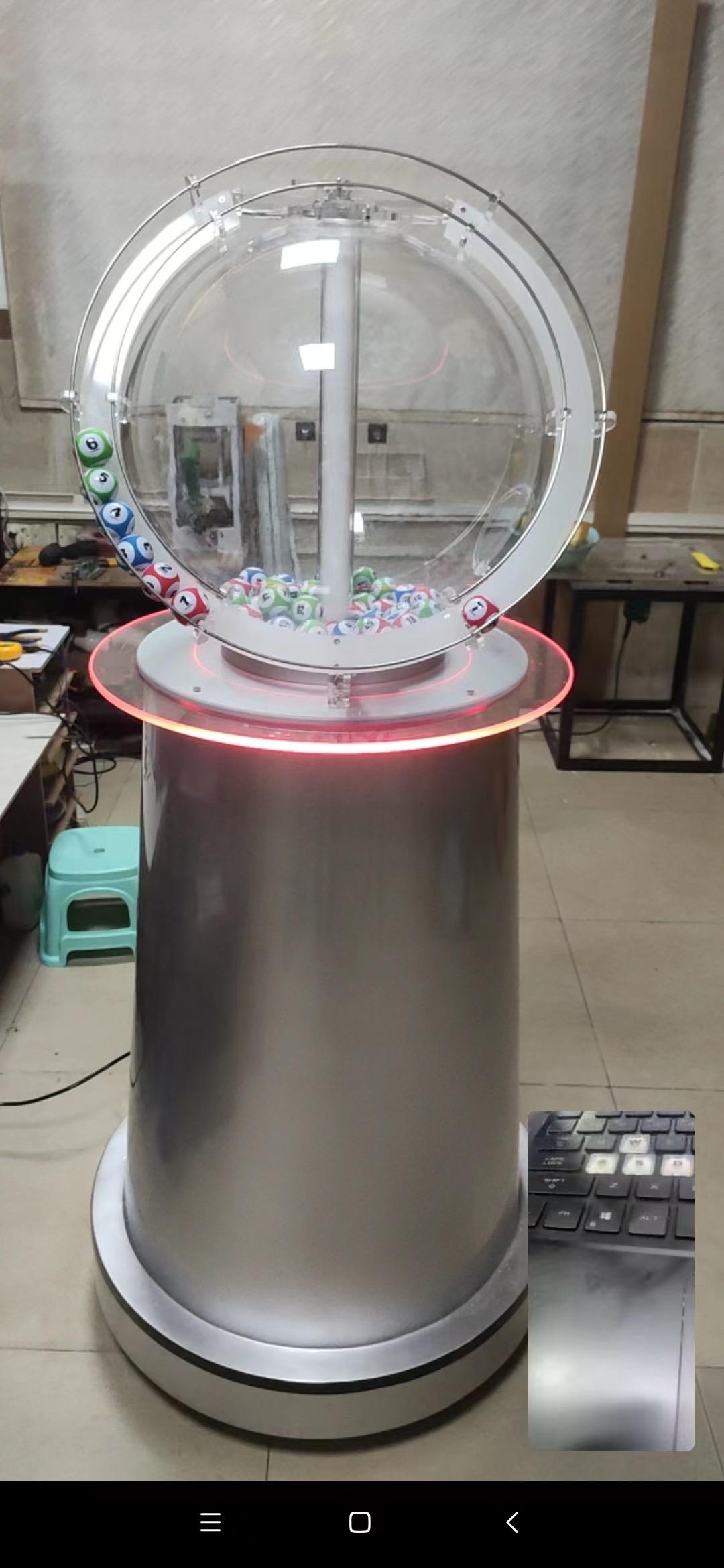
- Air-mix (air-blown) chambers: High-volume blowers inject air into a clear acrylic cylinder or sphere, lifting numbered balls into chaotic suspension before guiding one ball into an exit port or curved viewing track. Examples include the 1P420V 50-ball air-mix machine, the P800L and the 200-ball air-mix lotto machine.
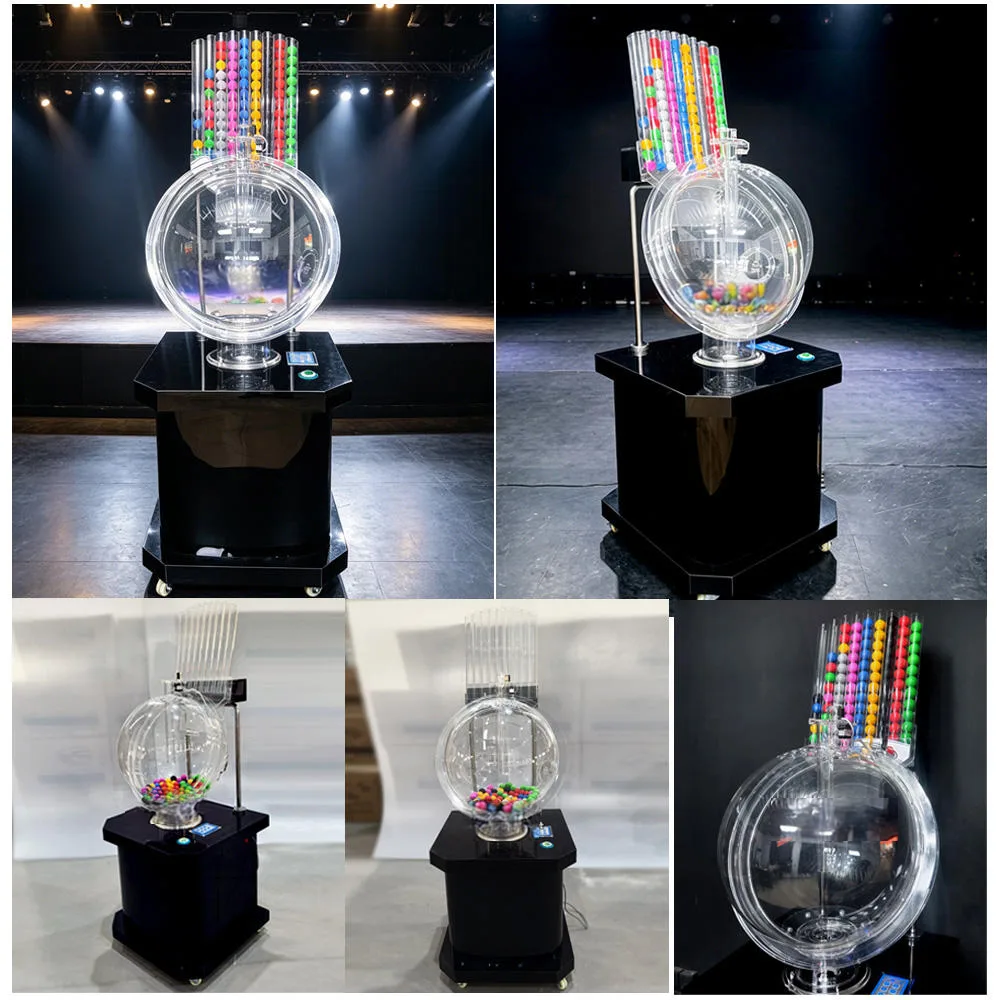
- Jet / top-ball air-mix towers: A vertical air-jet column circulates a compact pool—such as 50 balls in the New Top Ball Machine (NEW-dqj) (700 x 700 x 1900 mm)—and presents the selected ball at an elevated viewing position.
- Mechanical rotating-arm drums: Motorized paddles or three clockwise rotating arms sweep balls through a large transparent round drum toward the audience, as built on the J35V, J60, J800 and J2000V. Note that rotating-arm mechanical mixing should not be labeled gravity-pick unless a specific machine is built with a gravity-drop extraction gate.
Understanding that mechanical separation prevents the most expensive specification mistake in draw-equipment sourcing: asking an air blower sized for 50 solid balls to lift 500 balls, or ordering a large mechanical drum when your live show actually needs simultaneous five-digit position draws.
How do real Jisun air-mix and mechanical models compare on specs?
Rather than relying on abstract claims, compare documented specifications across Jisun's active air-mix and mechanical series. Notice how rated power, capacity ceiling and ball material shift sharply once you cross 200 balls or add multiple independent chambers:
| Model | Mixing Architecture | Reference Capacity & Ball Type | Reference Dimensions | Listed Power & Weight | Best Fit Workflow |
|---|---|---|---|---|---|
| 1P420V | Air-mix sphere | 50 solid balls (4 cm) | Counter-style base (confirm drawing) | Quoted per build | Single-pool lotto with curved front track; 3-ball screen view recommended |
| P800L | Air-mix chamber | 50 solid balls | 150 x 60 x 176 cm (L x W x H) | Quoted per build | Single-pool draw with optional RFID, data push and API |
| 200-Ball Lotto Machine | Air-mix chamber | 200 balls (customizable) | 640 x 640 x 1680 mm | 370 W / 70 kg | Mid-sized raffles, club draws and 15-second single-pool cycles |
| 5P350 | 5x air-mix cylinders | 5 chambers (custom 5P350V: 50 balls total) | 1750 x 620 x 1560 mm (5P350V: 1450 x 500 x 1500 mm) | 2500 W / 113 kg | Pick-5 sequential or simultaneous draws with automatic ball return |
| J35V | Mechanical rotating arms | 50 balls (solid or ping-pong to order) | 1200 x 500 x 400 mm (H x L x D) | 200 W / 85 kg | Compact mechanical draw at 15 s per ball |
| J60 | Mechanical rotating arms | 100 solid or 300 ping-pong balls (250 custom option) | 2000 x 670 x 610 mm (H x W x D) | Quoted per build | Tall vertical display rack for 100-300 ball events |
| J800 / J800V | 3 rotating arms (clockwise) | 500 table-tennis or solid balls | J800: 2000 x 905 x 605 mm; J800V: 1960 x 1140 x 660 mm | 200 W / 85 kg | High-capacity 500-ball raffles and large-pool promotional draws |
| J2000V | Mechanical rotating arms | 2,000 ping-pong balls | Confirmed on project drawing | Confirmed on project drawing | Ultra-high-pool prize draws where every entrant maps to one ball |
Two numbers in this table deserve extra attention from venue engineers. First, electrical load scales very differently: a 500-ball mechanical J800 draws 200 W, whereas a five-cylinder air-mix 5P350 draws 2500 W—meaning a standard 110-120 V venue branch circuit must be checked before plugging in a multi-chamber blower cabinet alongside stage lighting. Second, notice capacity scaling: once a single pool exceeds roughly 200 balls, mechanical rotating arms handle the added volume without needing oversized industrial blowers.
How does mixing architecture constrain ball material and diameter?
Ball physics are inseparable from chamber design. Mixing mechanisms interact with ball weight, bounce and surface friction in ways that directly affect draw consistency and wear. See our lottery machine ball size compatibility guide for sizing tolerances, and apply three selection rules when matching balls to machines:
- Solid EVA balls (typically 40 mm): Solid EVA balls have higher mass and softer impact surfaces than hollow plastic shells. They work well in dedicated air-mix systems such as the 1P420V, P800L, A6 (49 solid balls) and multi-cylinder Pick-N machines like the 3D-BLACK and 5P350, as well as mechanical drums rated for solid loads such as the J60 (100 solid balls).
- Hollow ping-pong / table-tennis balls (40 mm): Lighter balls allow much higher ball counts inside a given drum volume. On the J60, the same footprint moves from 100 solid balls up to 300 ping-pong balls, while the J2000V is specifically configured around 2,000 ping-pong balls.
- Never mix or substitute unverified ball weights: An air blower calibrated for 50 lightweight ping-pong balls may fail to lift 50 dense solid EVA balls evenly, while excessive airflow on lightweight balls can cause clumping near the upper baffle. Always specify both the primary working set and any numbered spare sets when confirming your order.
For broadcast and close-up camera checks, six-sided number printing—as documented on Jisun's 40 mm EVA numbered lottery balls—helps cameras and hosts read each result regardless of how the ball settles in the track.
When does air-mix outperform mechanical stirring?
Air-mix architecture wins decisively across four operational requirements where mechanical drums face physical trade-offs:
- Multi-digit position draws (Pick-2 through Pick-7): Games that draw independent digits (0-9 per chamber) need compact chambers aligned side by side. Air-blown cylinders allow two to seven chambers in one unified console—such as the 2D-280, 3D-BLACK, 5P350 and 7D-V1—with individual or simultaneous release.
- Hands-free automatic ball return between rounds: On multi-cylinder air-mix builds like the 3D-BLACK and 5P350, drawn balls return directly to their original chambers without staff opening the cabinet. Read our breakdown of automatic return versus manual reset workflows when calculating how many rounds per hour your hosts must run.
- Interactive hand-grab promotional draws: When guests reach inside a chamber to pick a ball on camera—as on the Z60 air-blown event ball grab machine (about 200 balls)—air suspension keeps balls moving cleanly without rigid spinning metal arms inside the reach zone.
- High-energy visual motion for small pools (10-90 balls): In 49-ball Mark Six formats (A6) or 75-90 ball bingo (G400), turbulent air mixing immediately signals vigorous agitation to an audience seated several meters away.
When should buyers specify a mechanical rotating-arm machine instead?
Mechanical rotating-arm equipment solves four distinct procurement problems that frequently trip up first-time buyers of air-blown cabinets:
- Single-pool draws above 200 balls: If every ticket, member or raffle entrant must correspond to a unique physical ball in one chamber—300, 500 or up to 2,000 balls—mechanical drums (J60, J800/J800V, J2000V) scale smoothly without exponential blower size or power demand. For events exceeding 2,000 tickets, compare single-pool drums against multi-digit Pick-N layouts in our high-capacity and 50,000-ticket draw guide.
- Tight venue power budgets: Because a 500-ball J800 or 50-ball J35V is rated at 200 W, hotel ballrooms, trade-show booths and mobile roadshows can power the machine from a standard single outlet alongside displays and audio gear.
- Controlled, unobstructed audience viewing of the mixing drum: Models like the J800 rotate three arms clockwise toward the viewing audience inside an open transparent drum, letting live spectators and close-up cameras watch continuous tumbling without blower turbulence obscuring ball clusters.
- Portable or lower-height event setups: Where ceiling height or door clearance restricts a 1.9-meter air-mix tower, compact mechanical units such as the JT800 (90 x 60 x 127 cm) or J35 (1200 x 500 x 460 mm) simplify transport between venues.
What noise, maintenance and integration checks should you request before ordering?
Neither air-mix nor mechanical mixing guarantees a trouble-free live event unless your pre-shipment checklist covers acoustics, electrical compatibility and optional electronics. Keep four engineering checks in your RFQ:
- Audio and video verification before crating: Do not guess how loud a blower or stirring motor sounds in your studio. Ask for an unedited factory operation video recorded with your exact ball material (solid EVA vs ping-pong) loaded at full pool capacity, following our demo video verification checklist.
- Separate display, camera and RFID scopes clearly: A front LCD or TV display does not automatically include RFID ball reading, and RFID reading does not automatically include software API push. Models like the 1P420V RFID, 1P800V and P800L support optional RFID, camera, data push or API integration as separately quoted items; confirm exact ball tag compatibility and output format in writing.
- Destination power and physical access: All Jisun draw machines can be customized to destination voltage, frequency and plug (such as 110-120 V / 60 Hz or 220-240 V / 50 Hz; wide-input models apply per their labeled range). Verify elevator door width and crate dimensions before booking freight, especially for wide multi-cylinder units like the 5P350 (1750 mm length) or tall 2000 mm mechanical drums.
- Cleaning and acrylic care: Transparent acrylic chambers scratch easily if wiped with abrasive pads or harsh chemicals. Clean exterior acrylic with a damp soft cloth and no special detergent, and store numbered balls in dedicated cases between events to protect printed numerals.
How should you brief Jisun for a tailored mixing-architecture recommendation?
Use the decision matrix below to narrow your configuration before requesting drawings or pricing:
| Your Primary Draw Constraint | Recommended Architecture | Starting Reference Models | Key Customization Items to Confirm |
|---|---|---|---|
| 10-50 solid balls, single chamber, compact show | Air-mix or jet top-ball | 1P420V, P800L, A6, NEW-dqj | Drawn-ball display count (3 recommended on 1P420V), RFID/camera option |
| Pick-2 to Pick-7 independent digits + fast repeat rounds | Multi-cylinder air-mix | 2D-280, 3D-BLACK, 5P350, 7D-V1 | Chambers count, sequential vs simultaneous release, circuit amperage |
| 100-500 balls in one pool, low 200 W power | Mechanical rotating arms | J60, J800, J800V, J500V | Solid vs ping-pong ball set, vertical rack height, pedestal finish |
| 500-2,000 ping-pong balls in one pool | Large mechanical drum | J800V (500), J2000V (2000) | Full-load drum dimensions, numbering sequence, export crate sizing |
| Guests grab balls directly on stage | Air-blown ball grab | Z60, Z40 | Access port height, branding wrap, ~200-ball working load |
Typical production lead time across standard and customized configurations is 7 to 15 working days after deposit and final specification confirmation, excluding shipping time. To compare side-by-side layouts and pricing for your exact game rules, contact Jisun to request a quote—send us your total ball pool, number of drawn balls per round, preferred ball material (solid EVA or ping pong ball lottery machines), electrical standard and whether you need camera, display or RFID options.
Equipment Discussed in This Guide
Use the model photos, available demonstrations and specification sheets to check the equipment discussed above. Specifications apply to each named model.
Frequently Asked Questions
- Is a mechanical rotating-arm lottery machine the same as a gravity-pick machine?
- Not automatically. Mechanical rotating-arm machines such as the J60, J800 and J2000V stir balls inside a transparent drum using rotating arms, whereas gravity-pick describes a specific bottom-drop extraction path. Confirm the exact extraction mechanism on the model drawing rather than assuming every mechanical drum uses gravity drop.
- Why does a multi-cylinder air-mix machine draw much more electrical power than a mechanical drum?
- Each air-blown chamber relies on blower airflow to suspend and mix balls. For example, the five-chamber 5P350 is rated at 2500 W across five air-blown cylinders, while the single-drum mechanical J800 (500 balls) and J35V (50 balls) list 200 W because a motorized arm assembly turns the balls instead of lifting them on continuous air streams.
- Can I switch between 40 mm solid EVA balls and hollow ping-pong balls inside the same machine?
- No, do not swap ball materials without verifying chamber tuning. Solid EVA balls are heavier than hollow ping-pong balls; blower airflow calibrated for one mass can under-mix heavier balls or pin lighter balls against the outlet. Confirm your exact ball diameter and material when ordering so the chamber and release path match.
- Which mixing style is quieter for close-microphone television or studio broadcasts?
- Acoustic output depends on blower speed, cabinet insulation, ball material and microphone placement, and Jisun does not publish measured decibel ratings across all models. In general, mechanical rotating arms eliminate continuous blower airflow noise, while solid EVA balls reduce hollow rattling compared with lightweight ping-pong balls. Request a live factory operation video with unedited audio before finalizing.
- How long does it take to manufacture a customized air-mix or mechanical lottery machine?
- Standard and customized Jisun lottery draw machines typically require 7 to 15 working days for production after deposit and final specification confirmation, excluding sea or air transit time. Destination voltage, frequency and plug are configured to order, including 110-120 V / 60 Hz or 220-240 V / 50 Hz.
Related Buying Guides
Automatic vs Interactive Lottery Draw Machine
A practical buyer guide for choosing automatic or interactive operation on a physical lottery draw machine. Covers workflow, timing, result verification, screens, consoles, and quotation inputs for Jisun custom builds.
High-Capacity & 50,000-Ticket Draws: Single Large-Pool Ball Machine vs Multi-Digit Pick System
Use a large single-pool ball machine when you have 100 to 2,000 entries and want every ticket mapped to one physical ball without replacement. Once entries pass 2,000—such as 5,000 to 50,000 competition tickets—switch to a multi-digit chamber machine with a pre-published valid-range and redraw rule.
Raffle Drum vs Ball Machine: Which Should You Buy?
Choose a paper-ticket raffle drum when you want to draw submitted entries directly. Choose a numbered-ball machine when your workflow uses a defined number pool, repeat draws and a clear link between each selected number and an eligible entry.