← Lottery Ball Machines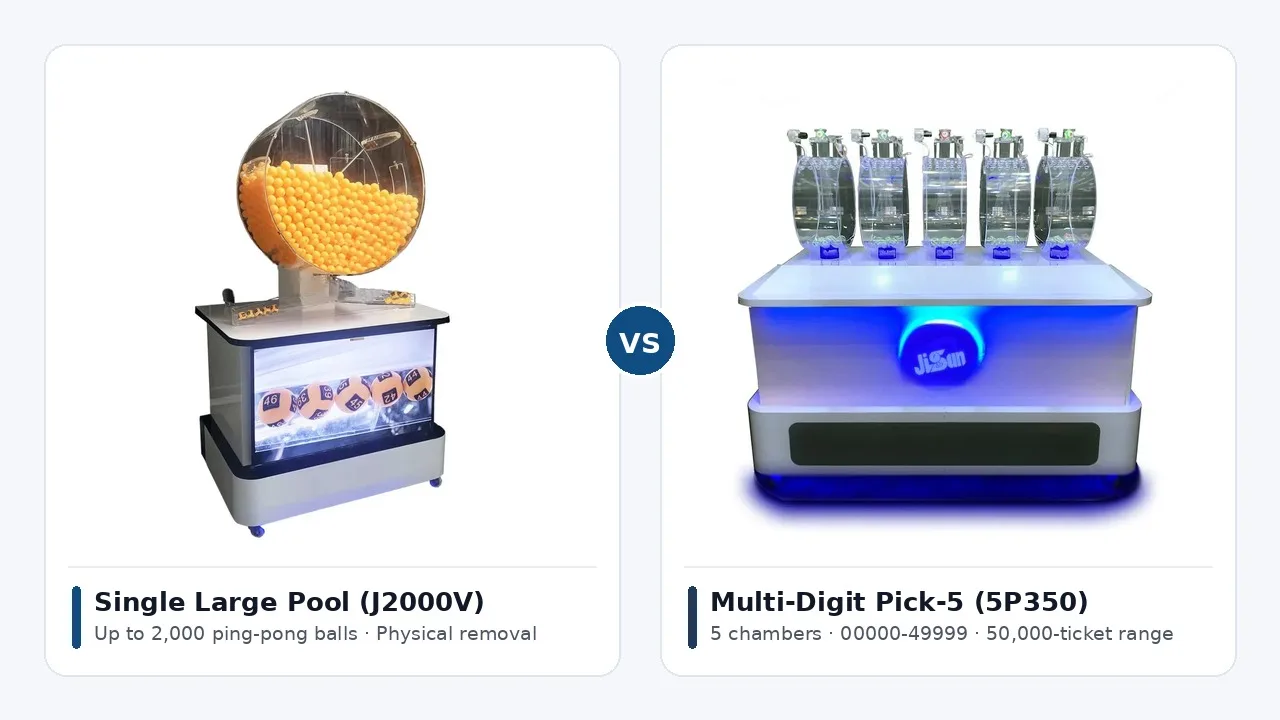
High-Capacity & 50,000-Ticket Draws: Single Large-Pool Ball Machine vs Multi-Digit Pick System
Use a large single-pool ball machine when you have 100 to 2,000 entries and want every ticket mapped to one physical ball without replacement. Once entries pass 2,000—such as 5,000 to 50,000 competition tickets—switch to a multi-digit chamber machine with a pre-published valid-range and redraw rule.
Written by Jisun Product Team
Buyers running large raffles or online prize competitions face one fundamental structural fork: load every entry as a separate physical ball inside a single large-pool drum (up to 2,000 balls), or compose each winning ticket number position by position using a multi-digit chamber machine (Pick-2 through Pick-7). Choosing the wrong side creates either impossible ball volumes or invalid ticket numbers on live camera.
Where is the practical cutoff between a single-pool machine and a multi-digit system?
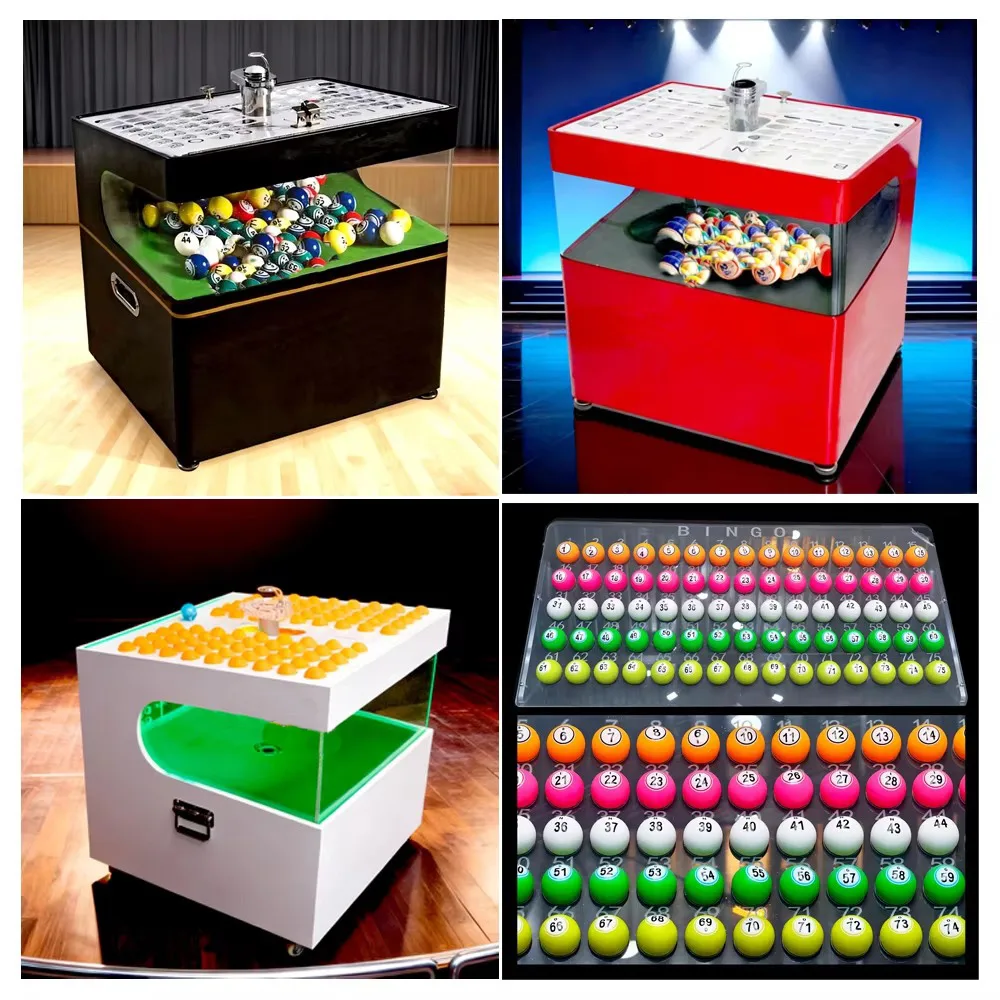
Many inquiries reach lottery draw machine manufacturers with a mismatched product link: a weekly three-digit club buyer browsing single-chamber lotto machines, or a charity asking for a "300-400 ball bingo blower" when standard bingo cabinets like the G350 and G400 top out at 75 to 90 balls (see how many balls are in bingo). Physical ball volume sets clear engineering boundaries:
| Total Eligible Tickets / Numbers | Recommended Hardware Structure | Reference Jisun Models | How Duplicate Winners Are Prevented | Key Operational Trade-Off |
|---|---|---|---|---|
| 1 to 200 entries | Single-pool air-mix or mechanical drum | 200-Ball Lotto Machine (370 W), J60 (100 solid / 300 ping-pong) | Physical removal from chamber (no replacement) | Fastest audience understanding; zero software lookup needed during rounds |
| 201 to 500 entries | Large mechanical rotating-arm drum (or 3D digit draw) | J60 (300 ping-pong), J800 / J800V (500 balls, 200 W) | Physical removal from drum | Larger footprint (2000 mm height on J800); manual set reconciliation between events |
| 501 to 2,000 entries | Ultra-large mechanical ping-pong drum (or 4D digit draw) | J2000V (2,000 ping-pong balls) | Physical removal from drum | High ball-inspection labor; 2,000 numbered balls take longer to verify and store |
| 2,001 to 99,999 entries (e.g., 50,000 tickets) | 4- or 5-cylinder multi-digit machine | 5P350, 5P350V2 (5 chambers, up to 10 balls/chamber) | Software/ledger check + redraw if already won | Only 40-50 balls total to inspect; requires explicit valid-range rules |
| 100,000 to 9,999,999 entries | 6- or 7-cylinder multi-digit machine | 6P350, 7D-V1 (7 chambers, 7 screens) | Software/ledger check + redraw if already won | Wide stage footprint (258 cm length on 7D-V1); verify power and doorway width |
As a rule of thumb, single-pool draws shine up to 500 balls—and remain viable up to 2,000 balls on the J2000V when organizers specifically want every ticket visible as one physical ping-pong ball (see our air-mix vs mechanical lottery machine comparison for motor wattage and ball-material trade-offs). Beyond 2,000 entries, physical single-pool storage, pre-draw ball verification and mixing ergonomics break down rapidly, making independent digit chambers the standard physical draw solution.
How do you design a 50,000-ticket draw on a five-cylinder machine?
Competition companies frequently ask whether buying a five-chamber machine automatically handles a 50,000-ticket raffle. It does not—unless you configure chamber loading and ticket numbering together. Five standard chambers holding balls 0 through 9 produce 100,000 possible combinations (00000 to 99999). If you only sold 50,000 tickets (1 to 50,000), half of all draws would land on invalid numbers unless you engineer the pool correctly.
Organizers solve this cleanly using one of three documented workflows:
- Exact-range first-chamber loading (cleanest for 50,000 tickets): Load chamber 1 (the ten-thousands digit) with only 5 balls—0, 1, 2, 3, 4—and load chambers 2 through 5 with 10 balls each (0 through 9). That produces exactly 5 x 10 x 10 x 10 x 10 = 50,000 combinations from 00000 to 49999. Map 00000 to ticket #50,000 (or issue tickets numbered 00000–49999 from the start). Every single pull yields a valid ticket number on the first try with zero wasted airtime.
- Irregular ticket caps (for example, 37,420 sold tickets): Load chamber 1 with 0, 1, 2, 3 (covering 00000–39999, or 40,000 total outcomes) instead of 0–9. That cuts the out-of-range rejection rate from 62.6% down to 6.45%. Publish a clear rule in advance: if the drawn number exceeds 37,420 or hits 00000, all five balls return to their chambers and the entire five-digit draw repeats cleanly—never redraw only the invalid digit, which distorts probability across the remaining positions.
- Sequential vs. simultaneous reveal for live suspense: On models like the 5P350, chambers can select digits individually in sequence or simultaneously across all five pools. Sequential reveal (left to right or right to left) builds tension on livestreams and gives moderators two to three seconds per digit to confirm readability before calling the full ticket number.
Notice one critical compliance boundary: never attempt to "skip" unsold gaps by shifting a drawn number up or down to the nearest sold ticket. That gives tickets immediately following an unsold block disproportionately higher odds. Always freeze the entry list before the draw (see our numbered-ball raffle runbook) and redraw the full combination if an unallocated number appears.
Why do 300- to 400-ball "bingo" requests need a different machine than 75- or 90-ball bingo?
Clubs, trade associations and fundraising hosts often use the word "bingo machine" as shorthand for any numbered-ball blower—even when they need 300 or 400 numbered balls. Checking that assumption early prevents costly re-engineering:
- Standard bingo cabinets are purpose-built for 75 to 90 balls: The G350 supports 75-, 80-, 85- or 90-ball sets matched to a top checking board, and the G400 is built for 90-ball draws with a flat checking tray. Overloading a 90-ball blower chamber with 350 balls restricts airflow and prevents proper ball separation.
- 300- to 500-ball single-pool alternatives: If you truly want one physical ball per member without replacement, specify a mechanical rotating-arm unit sized for that volume—such as the J60 (configured for 300 ping-pong balls or 250 balls custom) or the J800 (500 table-tennis or solid balls at 200 W).
- 3-digit multi-chamber alternative for 300–999 tickets: If you only draw one to five winners per night and want faster setup than inspecting 400 balls, a three-cylinder machine like the 3D-BLACK (3 chambers, auto-return) lets you load 0–3 in chamber 1 and 0–9 in chambers 2 and 3—using just 24 physical balls total instead of 400.
How should you handle multi-round draws without repeat winners?
Buyers running a 200-ticket charity gala or a 10-prize corporate giveaway often overlook reset behavior until rehearsal day. Single-pool and multi-digit machines behave completely differently across multiple prize rounds:
- Single-pool removal (physical lock-out): On a 200-Ball Lotto Drawing Machine or 500-ball J800, each winning ball stays out in the result rack or checking tray. It physically cannot be drawn again during the same evening, and spectators can see previous winning balls lined up transparently.
- Multi-digit return (procedural lock-out): On a 2D, 3D, 5D or 7D digit machine (2D-280, 3D-BLACK, 5P350, 7D-V1), each chamber returns its ball so that every digit 0–9 remains available for the next prize draw. Otherwise, drawing ticket 14582 would make it impossible for ticket 19000 to win the next round. Organizers simply check the frozen winner register after each draw and trigger a clean redraw if a previous winning ticket recurs.
If your event awards 20 or more prizes in rapid succession to under 200 guests, single-pool physical removal saves host commentary and eliminates repeat-winner redraws. If you award 1 to 10 high-value prizes from thousands of entries, multi-digit auto-return wins on preparation speed and stage drama.
What display, camera and RFID options actually matter for high-ticket livestream draws?
When a draw determines a high-value competition prize in front of an online audience, legibility and auditability drive hardware selection far more than cabinet paint color. Buyers should separate four distinct hardware layers when requesting a quotation:
| Layer | What It Does | Example Models Supporting Option | Common Buyer Misconception to Avoid |
|---|---|---|---|
| Physical viewing window & six-sided ball print | Keeps every drawn ball legible on camera regardless of landing angle | 5P350, 5P350V2, 7D-V1 (six-sided printed 40 mm EVA balls) | Assuming two-sided printing is enough for fixed broadcast cameras |
| Cabinet LCD / LED / TV screens | Displays large digits for studio audiences and wide camera shots | 5P350V2 (standalone big screen), 7D-V1 (7 front screens) | Assuming built-in screens automatically include RFID ball reading |
| Optional RFID reading | Electronically reads tagged balls as they enter the result position | 5P350V2 (optional), 7D-V1 (optional), 1P420V RFID, 1P800V | Mixing non-RFID replacement balls into an RFID-configured draw |
| Optional data push / API / website output | Feeds captured draw results into external graphics or web systems | Quoted separately on 5P350V2, 7D-V1, P800L, G350 | Assuming plug-and-play software compatibility without confirming protocol before production |
Before shipping any high-capacity or multi-digit unit, verify every layer during factory inspection using our lottery draw machine factory acceptance testing guide—especially full-load mixing, digit-by-digit release timing, ball return clearance and screen visibility under camera lighting.
What specifications should you send to configure a large-pool or multi-digit draw machine?
Whether you need a 300- to 2,000-ball single drum or a 5- to 7-cylinder digit system for 50,000+ tickets, four inputs allow engineering to quote an accurate build within our typical 7 to 15 working days production lead time (excluding transit):
- Maximum ticket or entry count: State both your current draw size and peak promotional cap (for example, 300 members today vs. 50,000 online tickets next quarter).
- Prizes per session and repeat-winner rule: Confirm whether winners are removed from subsequent rounds and how many rounds occur per hour.
- Presentation and integration scope: Specify whether you need standalone physical display tracks, front LCD screens, camera mounts, optional RFID ball reading or external data/API output.
- Site power and room clearance: Destination voltage, frequency and plug are customized to order (including 110-120 V / 60 Hz or 220-240 V / 50 Hz). Note that wide multi-cylinder units such as the 5P350 (1750 mm length, 113 kg, 2500 W) and 7D-V1 (2580 mm length) require advance doorway and electrical-circuit checks.
Need help mapping your exact ticket range to a single large-pool drum or a multi-cylinder Pick-N build? Contact Jisun to request a quote and send us your maximum ticket count, rounds per draw, preferred display or RFID options and destination country for a written specification and quotation.
Explore our dedicated Pick 3, Pick 4 & Pick 5 multi-chamber lottery draw machines to compare 3D-7D cabinet widths, rated power, overhead cameras and RFID options side by side.
Equipment Discussed in This Guide
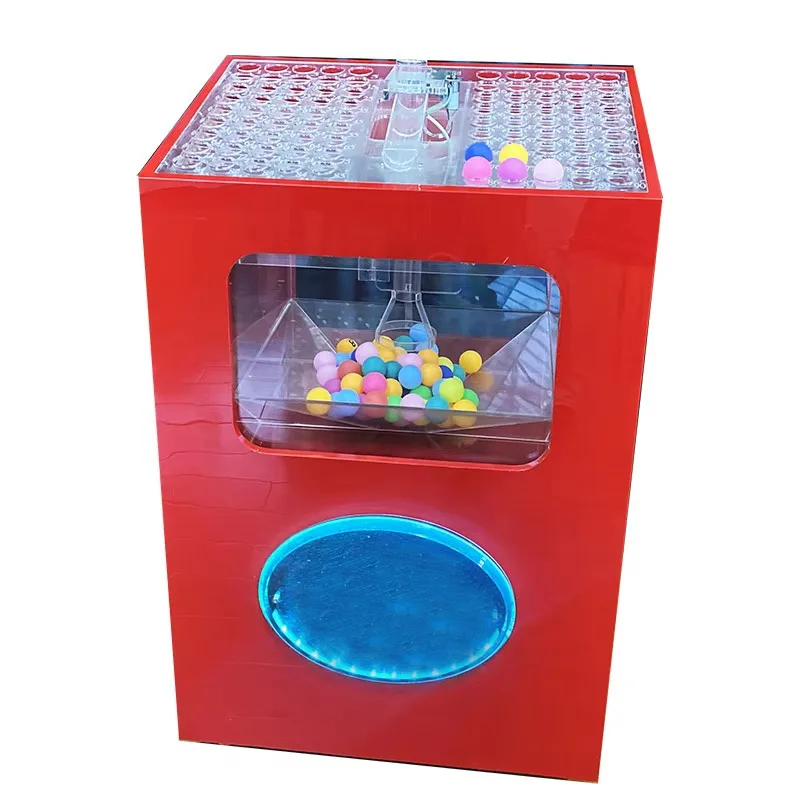
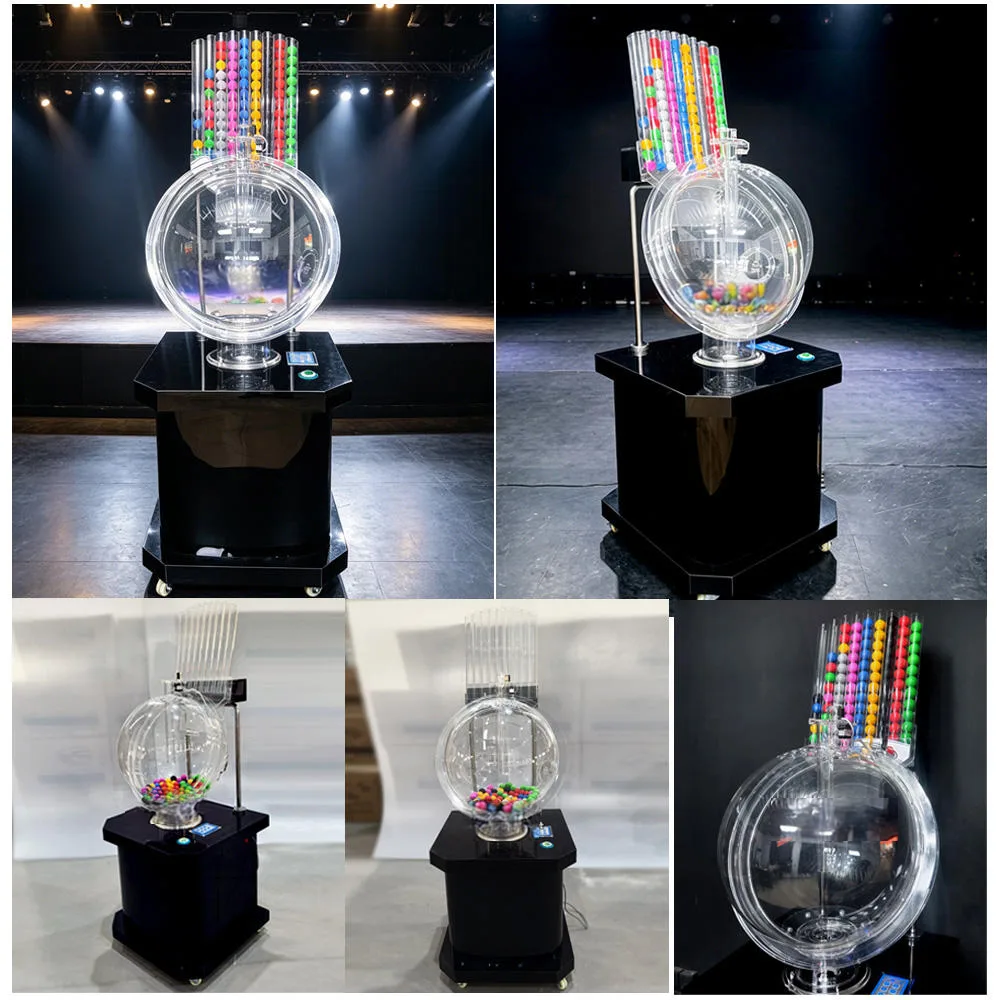
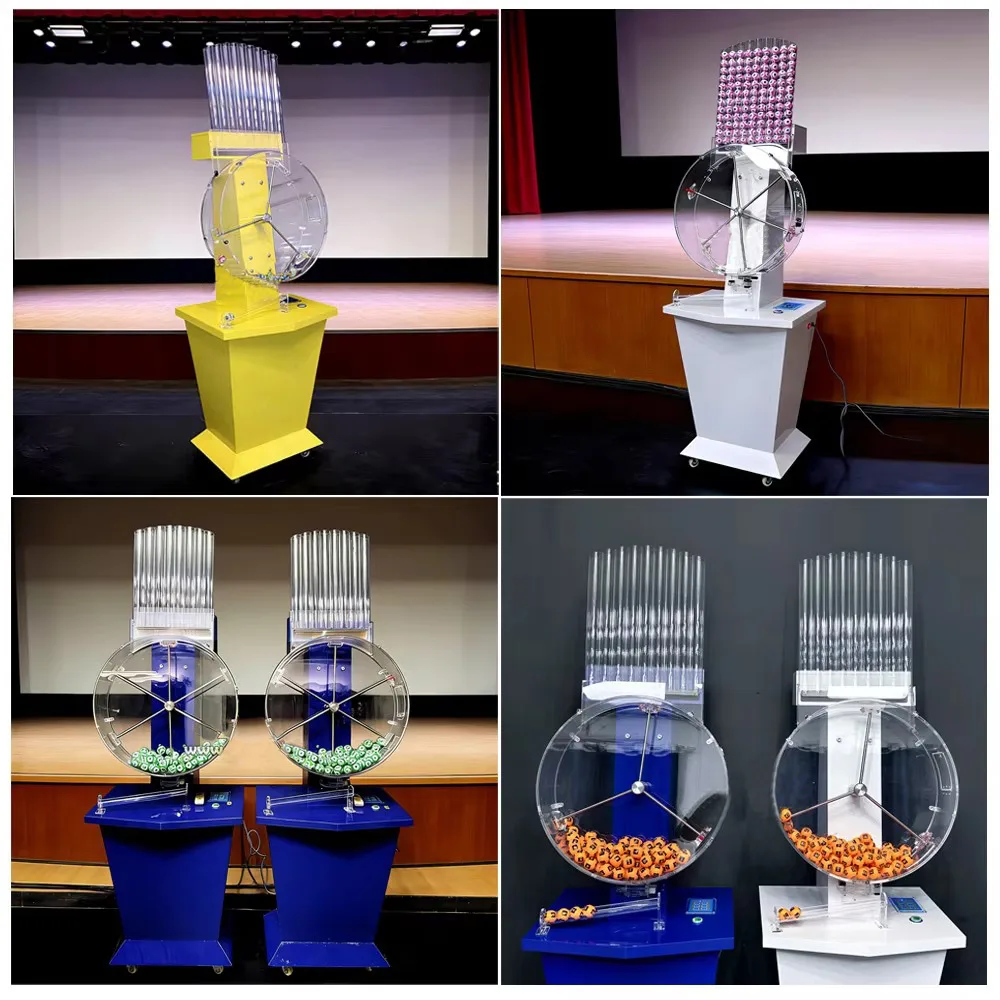
Use the model photos, available demonstrations and specification sheets to check the equipment discussed above. Specifications apply to each named model.
Frequently Asked Questions
- Can a standard 75-ball or 90-ball bingo machine hold 300 to 400 balls for a larger club draw?
- No. Standard bingo machines such as the G350 (75, 80, 85 or 90 balls) and G400 (90-ball reference format) have chambers and checking trays sized for standard bingo sets. For a 300- to 400-ball single pool, move to a large mechanical drum such as the J60 (300 ping-pong balls), J800 (500 balls), or switch to a three-cylinder digit machine.
- How do competition companies draw a winner from 50,000 tickets with a five-cylinder machine without unfair odds?
- Load the first chamber with digits 0 through 4 (5 balls) and chambers two through five with 0 through 9 (10 balls each). That creates exactly 50,000 equiprobable five-digit outcomes from 00000 to 49999—mapping 00000 to ticket 50,000 (or using 0-indexed tickets) removes out-of-range redraws completely.
- What happens if a multi-digit draw produces a ticket number that was never sold or already won?
- Because digit chambers return balls and can repeat combinations across rounds, organizers must publish a written redraw rule before starting. Freeze the final sold-ticket register before mixing, verify each drawn number against the register, and re-run the full multi-digit draw if the result lands outside the sold range or hits a previous winner.
- Does a five-cylinder machine with front displays automatically feed numbers into a live-stream graphics system?
- No. Front LCD screens or display strips show numbers visually on the cabinet, while RFID ball reading, website data push and API output are separate optional functions quoted according to your integration scope—as noted on the 5P350V2 and 7D-V1. Specify your exact display and software output requirements before production.
- When is a 200-ball or 500-ball single-pool machine better than a 3-digit machine for a multi-prize raffle?
- A single-pool machine physically removes each drawn ball from the mixing chamber, preventing duplicate winning numbers across consecutive prize rounds without manual cross-checking. If your total entries fit inside a 200-ball air-mix unit or a 500-ball J800 mechanical drum and you award multiple prizes in one evening, single-pool removal keeps the stage pacing simpler.
Related Buying Guides
Automatic vs Interactive Lottery Draw Machine
A practical buyer guide for choosing automatic or interactive operation on a physical lottery draw machine. Covers workflow, timing, result verification, screens, consoles, and quotation inputs for Jisun custom builds.
Air-Mix vs Mechanical Lottery Machines: Comparing Capacity, Ball Type, Power and Draw Workflow
Air-mix lottery machines use airflow in transparent chambers for fast 10–200 ball draws and multi-cylinder digit games. Mechanical rotating-arm machines tumble 50 to 2,000 solid or ping-pong balls at lower motor wattage when large single pools and open front viewing matter most.
Raffle Drum vs Ball Machine: Which Should You Buy?
Choose a paper-ticket raffle drum when you want to draw submitted entries directly. Choose a numbered-ball machine when your workflow uses a defined number pool, repeat draws and a clear link between each selected number and an eligible entry.