Concept / Customizable Design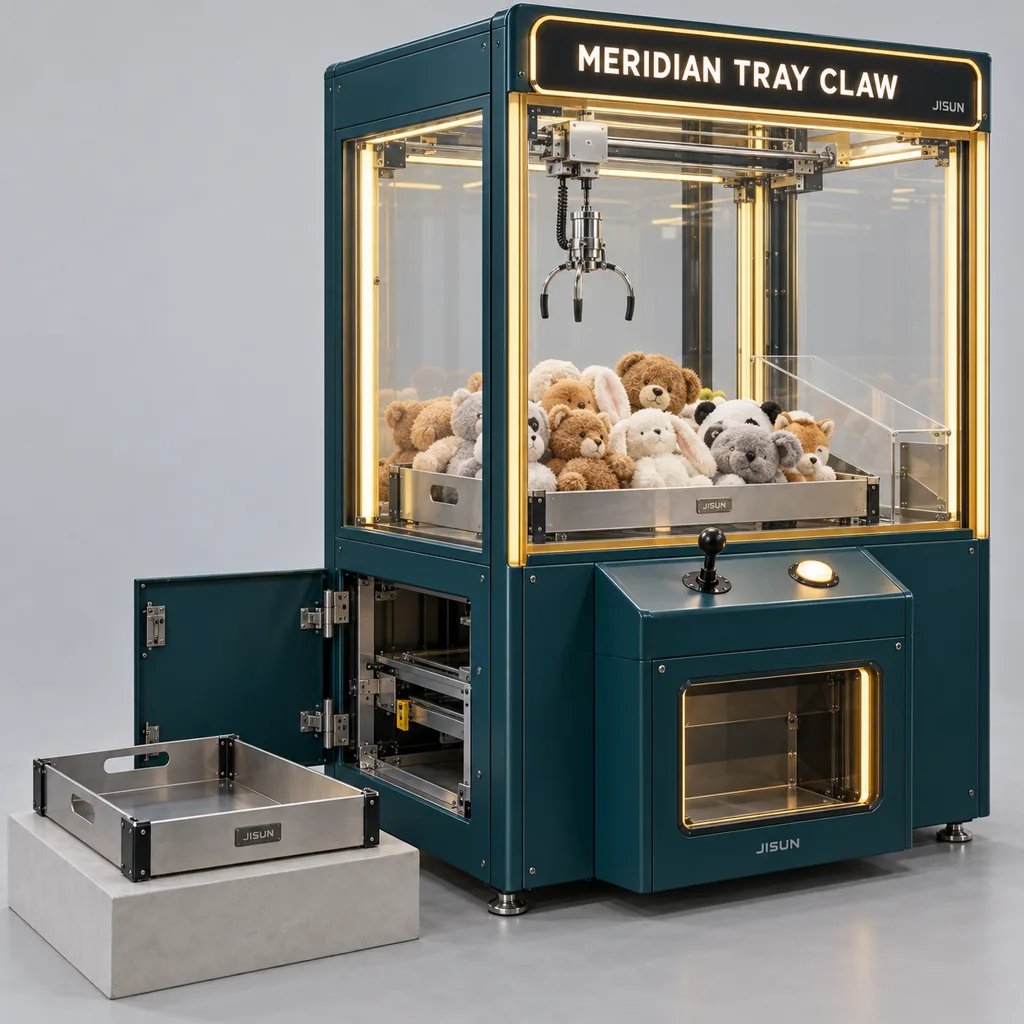
Category: Claw Machines
Meridian Tray Claw
Concept design — fully customizable. Contact us to make it real.
- ✓Proposed removable prize tray seats on locating guides beneath a conventional overhead claw.
- ✓Separate service access supports planned tray changes while the machine is out of play.
- ✓Stationary prize bed and dedicated collection chute preserve familiar claw gameplay.
- ✓Tray labels and replenishment records help operators compare assortment costs and play income.
- ✓Teal cabinet, clear prize windows and an amber frame create a focused mall arcade display.
A claw concept for understanding operating margins
Concept design — fully customizable. Contact us to make it real.
Meridian Tray Claw is a proposed single-player cabinet for an independent shopping mall arcade operator testing a first claw location. Its starting problem is practical: busy play does not reveal how much money remains after prizes, payment fees, venue charges and servicing. Changing prize assortments without recording what changed also makes operating results difficult to interpret. This concept pairs conventional claw play with an exchangeable prize bed and a structured replenishment workflow, helping the operator keep useful records while presenting a clear, attractive physical prize display.
The proposed appearance combines a deep teal metal base, clear glass display panels and warm white lighting. A narrow amber border frames the play window, while a replaceable header carries the operator's identity. Players use a joystick and drop button to position a suspended claw above actual prizes. The visible objects, their arrangement and the physical retrieval attempt are central to the experience; a screen alone cannot provide that interaction.
An exchangeable tray beneath a conventional claw
The proposed mechanism uses a conventional overhead claw carriage above a removable prize tray. Locating guides would seat the tray in a repeatable position, with a retaining latch securing it during play. A separate prize chute would lead to the player collection hatch. The tray is a service component: it stays stationary throughout each game and does not dispense prizes itself.
A custom lower service door would provide access for tray removal when the machine is out of play. The design target is to exchange a prepared tray without dismantling the overhead carriage. Tray depth, extraction direction, handling weight and door clearance depend on the selected prizes and cabinet envelope. A shallow tray for small plush and a deeper tray for bulkier items are alternative custom directions, each requiring a compatible claw, travel range and chute opening. Changing trays would not automatically make different prizes mechanically compatible.
As a custom control option, the service door could include an interlock intended to inhibit carriage movement while open. A local tray label and service log could identify the prize assortment used during each operating period. Neither the label nor the tray determines a winning outcome.
Prepare, run and reset
Before opening, staff would take the machine out of play, load suitable prizes into the selected tray, record the starting quantity and seat and secure the tray. They would then check the chute, close the service door and run a service cycle before enabling paid play. During operation, players would steer the claw and press the drop button; the proposed cycle lowers, closes, lifts and returns the claw toward the collection chute.
Between games, the carriage would return to its home position. Staff would periodically inspect the prize bed because an automatic carriage reset does not restore displaced prizes. At replenishment or an assortment change, staff would disable play, record remaining stock and additions, and either reload the tray or exchange it. Optional play and prize-exit counters could support recordkeeping, but staff would still reconcile stock, complimentary games and payment records.
Compare results without promising earnings
The operator could compare recorded play income with prize consumption, payment fees, venue costs and service expenses over defined periods. No earnings or payback figure is proposed. Foot traffic, pricing, prize appeal, downtime and local operating costs all affect the result. Keeping the assortment and settings documented helps explain changes; it does not prove that one change caused a revenue difference.
For a simpler installation, Jisun's existing Mini Claw Machine already provides a compact claw format designed for 10–15 cm prize items, with a standard coin acceptor and optional bill acceptor and Nayax card payment. It is sufficient when staff can replenish prizes through the usual service routine and do not need exchangeable trays. Meridian Tray Claw instead proposes a dedicated removable prize bed and associated service access. The existing model's specifications do not establish this concept's dimensions, tray performance or payment compatibility.
Define the equipment around the site
Jisun needs the intended prize dimensions, weight, shape and quantity; planned game sequence and controls; available installation space; service access; local electrical supply; and payment requirements. These inputs determine tray handling, claw selection, cabinet proportions and integration feasibility. Branding, lighting, tray geometry and payment interfaces are custom options. Cabinet dimensions, power, tray capacity and packed shipping measurements remain to be established for the selected configuration.
Production usually takes 7-15 working days after deposit and final specification confirmation. Shipping time is additional; the final schedule is confirmed in the quotation. Get a Quote with your venue layout and prize plan to develop this concept into a defined equipment configuration.
What Should Be Confirmed Before Engineering?
Who This Concept Is For
- Independent mall arcade operators testing their first claw location
- Small arcade owners comparing prize assortments at a mall site
- Mall entertainment concession operators with scheduled replenishment staff
Configuration Directions
- Custom shallow or deep prize trays matched to the intended prize assortment
- Custom tray extraction direction and service-door layout matched to site access
- Optional service-door interlock intended to inhibit carriage movement while open
- Optional local play and prize-exit counters for operating records
- Optional coin, bill or cashless payment integration subject to interface and market requirements
- Custom claw geometry, carriage travel and chute opening matched to prize characteristics
- Optional replaceable branding header, cabinet graphics and adjustable display lighting
Operator and Site Requirements
- Confirm sufficient clearance to open the service door and extract a loaded tray.
- Assign staff to disable play before tray handling and check tray retention before reopening.
- Confirm a level indoor installation position, electrical supply and access route.
- Maintain prize stock, replenishment and payment records for operating comparisons.
- Inspect displaced prizes and the collection chute during routine servicing.
Inputs We Need From the Buyer
- Prize dimensions, weights, shapes, packaging and intended assortment
- Desired starting prize quantity and replenishment frequency
- Available cabinet space, service clearance and delivery access measurements
- Intended game sequence, joystick and button preferences, and service controls
- Destination country, electrical supply and plug requirements
- Payment methods, preferred payment provider and available connectivity
- Brand artwork, color preferences and display-lighting requirements
- Equipment quantity, delivery destination and target installation date
Existing Equipment to Compare
These photos and demonstrations show the existing models cited above. They do not show a completed version of this concept; each model keeps its own specifications.
Customization Questions
- Does the Meridian Tray Claw tray move during a player's attempt?
- No. In the proposed design, the tray remains seated and secured during play. The overhead claw moves above it, and retrieved prizes travel through a separate collection chute.
- Can staff exchange a tray while paid play remains enabled?
- The proposed workflow requires staff to disable play before opening the service door. After exchanging the tray, staff secure it, check the chute, close the door and run a service cycle before reopening.
- Would exchanging trays let us switch between any two prize sizes?
- Tray exchange alone does not establish compatibility. Prize dimensions, weight and shape must suit the claw, carriage travel and chute opening. Different assortments may require different mechanical configurations.
- How would the tray workflow help us assess operating margins?
- Staff record starting stock, remaining prizes and replenishment for each identified assortment, then compare play income with prize consumption and operating expenses. Optional counters can support those records, but they do not establish earnings or payback.