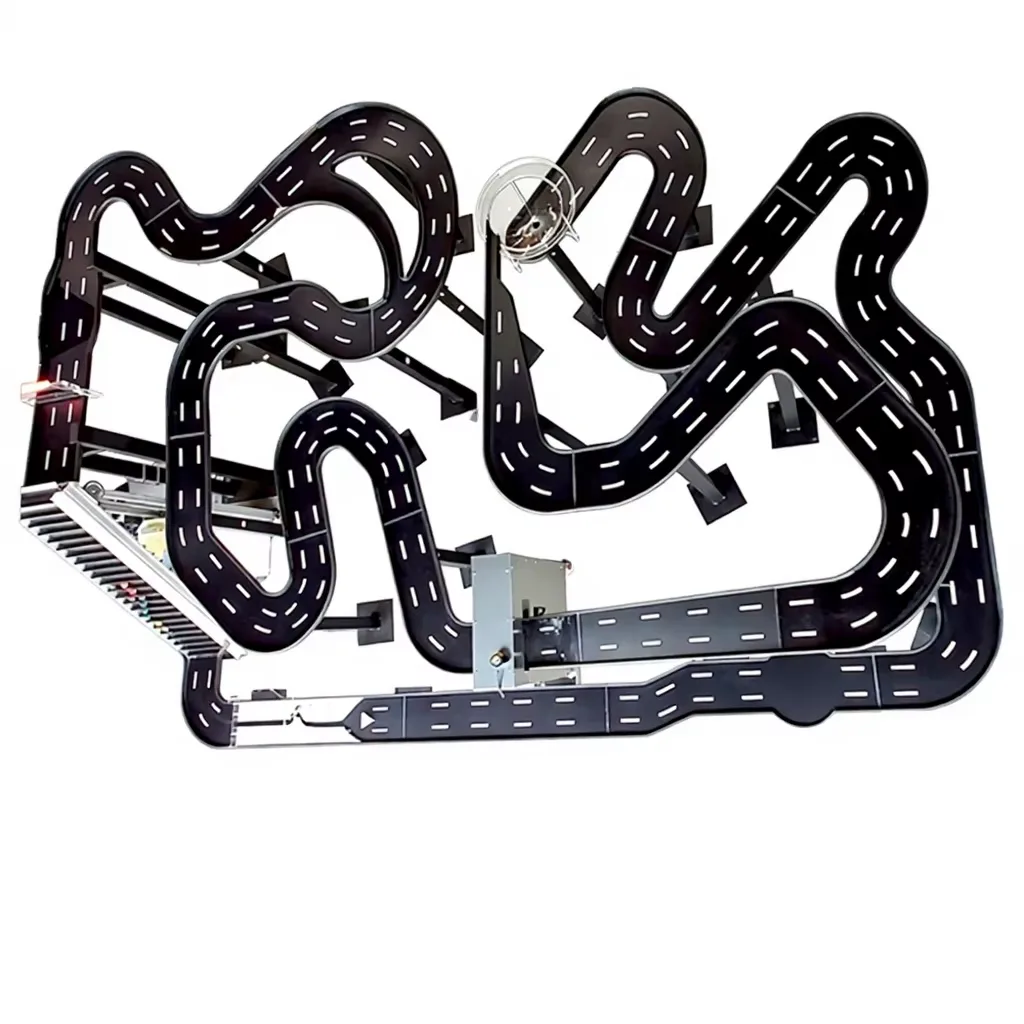
No.10 Custom Marble Race Track with Multi-Level Turns
Model: Marble Race No.10
Category: Custom Marble Race Tracks
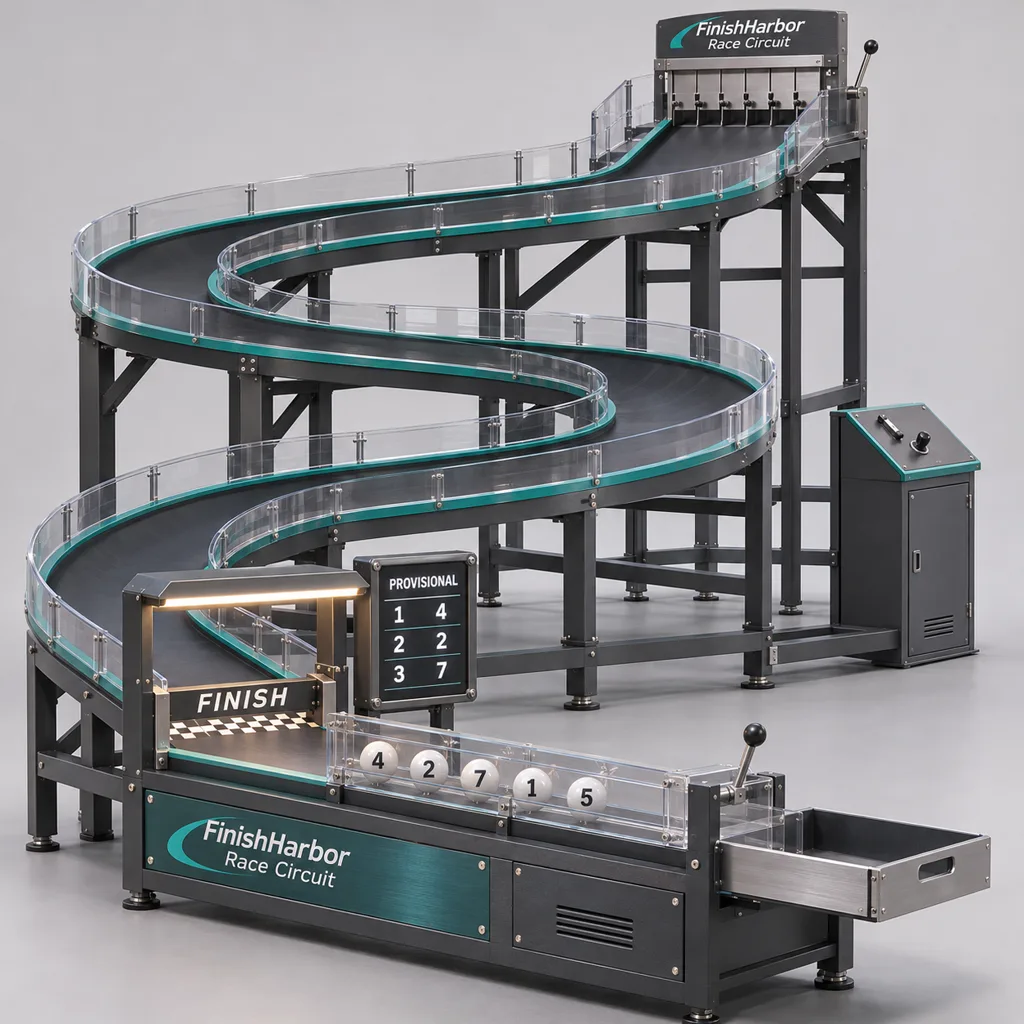
Concept design — fully customizable. Contact us to make it real.
Concept design — fully customizable. Contact us to make it real.
FinishHarbor Race Circuit is a proposed custom marble race track for a family entertainment center running scheduled spectator races. It addresses one operating problem: staff need to explain the finishing order to a crowd without reaching across the circuit or immediately clearing away the balls. The concept places the finish channel, result display and collection access together along one viewing edge. Physical numbered balls travel through a visible circuit, giving spectators a shared event to follow and staff a tangible finishing sequence to inspect.
The proposed appearance combines a charcoal support frame, teal track edges and a warm white illuminated finish canopy. Sweeping elevated curves lead toward a straight final approach facing the audience. Clear containment panels preserve sightlines while separating spectators from moving balls. An operator service side provides access to the collection tray and controls; its position would follow the venue floor plan.
The proposed mechanism uses a common start gate, a gravity-driven race circuit and a final transition into a single-file finish channel. That transition is part of the race: the defined finish line sits downstream of it. Channel geometry would be developed around the selected ball diameter to discourage side-by-side passage and overtaking after the finish line. The design must also address rebound, blockage and access for clearing a stopped ball.
As a custom option, compatible tagged balls and a finish reader could associate detected arrivals with ball numbers. A proposed display would show provisional finish order, followed by an operator-confirmed result. Closely spaced arrivals, missed identities or unexpected repeat readings would flag an exception instead of silently assigning a complete ranking. Reader arrangement, spacing and achievable identification performance require validation with the agreed balls and track geometry. The concept does not promise timing resolution or guaranteed detection.
A clear downstream holding channel is proposed to retain the physical arrival sequence for inspection before collection. Its length and access arrangement depend on the field size. An example design target is a ten-ball race; this is a starting point for discussion, not an established capacity. Larger fields would require review of start spacing, track congestion, finish storage and reset time. An external screen connection is another custom option, with the display interface and result states agreed before engineering.
Before a session, staff check the numbered ball set, inspect the track and finish channel, confirm containment panels are secure and clear the collection area. Where electronic identification is specified, staff also check that each ball identity matches its displayed number. They load the start positions, select a fresh race and confirm that the finish channel is empty before releasing the common gate.
During a race, the operator monitors the circuit and provisional results. A remote control option could release the start gate or stop powered equipment; it would not select a winning ball or control the outcome. If a ball stalls or the finish system reports an exception, staff hold the result and follow the agreed interruption procedure. Access to moving return equipment would require it to be stopped first.
After result confirmation, staff release the retained balls into an accessible collection tray. Manual transfer back to the start is the proposed baseline. A guarded powered return could be developed as an alternative, subject to lift height, service clearance and the intended race interval. Clearing the screen alone would not reset the equipment: staff must reconcile the ball set, empty the finish channel and reload the start. Routine care would include checking track joints, reader windows, gate movement and collection access.
Jisun's No.10 Custom Marble Race Track with Multi-Level Turns references ten numbered balls, a common start, a multi-level black circuit and finish-order ranking, with RFID timing, live ranking and broadcast integration listed as options. That model is a relevant starting point when a venue needs a conventional spectator circuit with a project-specific size and return arrangement.
FinishHarbor instead proposes a viewing-edge finish assembly that retains the arrival sequence, separates provisional results from confirmed results and concentrates reset access on the service side. These workflow and mechanism differences define the concept; the existing model does not establish that this proposed assembly has been built or tested.
Jisun needs the intended ball count, diameter, material and identification method; the race and result-confirmation workflow; available footprint and height; delivery access; spectator circulation; and maintenance clearances. Buyers should also identify their preferred return method, control location, external screen interface and destination electrical supply. These inputs determine whether the proposed finish storage, track layout and operating sequence are practical.
Production usually takes 7-15 working days after deposit and final specification confirmation. Shipping time is additional; the final schedule is confirmed in the quotation. Get a Quote with your floor plan and race workflow to develop FinishHarbor for your venue.
These photos and demonstrations show the existing models cited above. They do not show a completed version of this concept; each model keeps its own specifications.
Model: Marble Race No.10