Concept / Customizable Design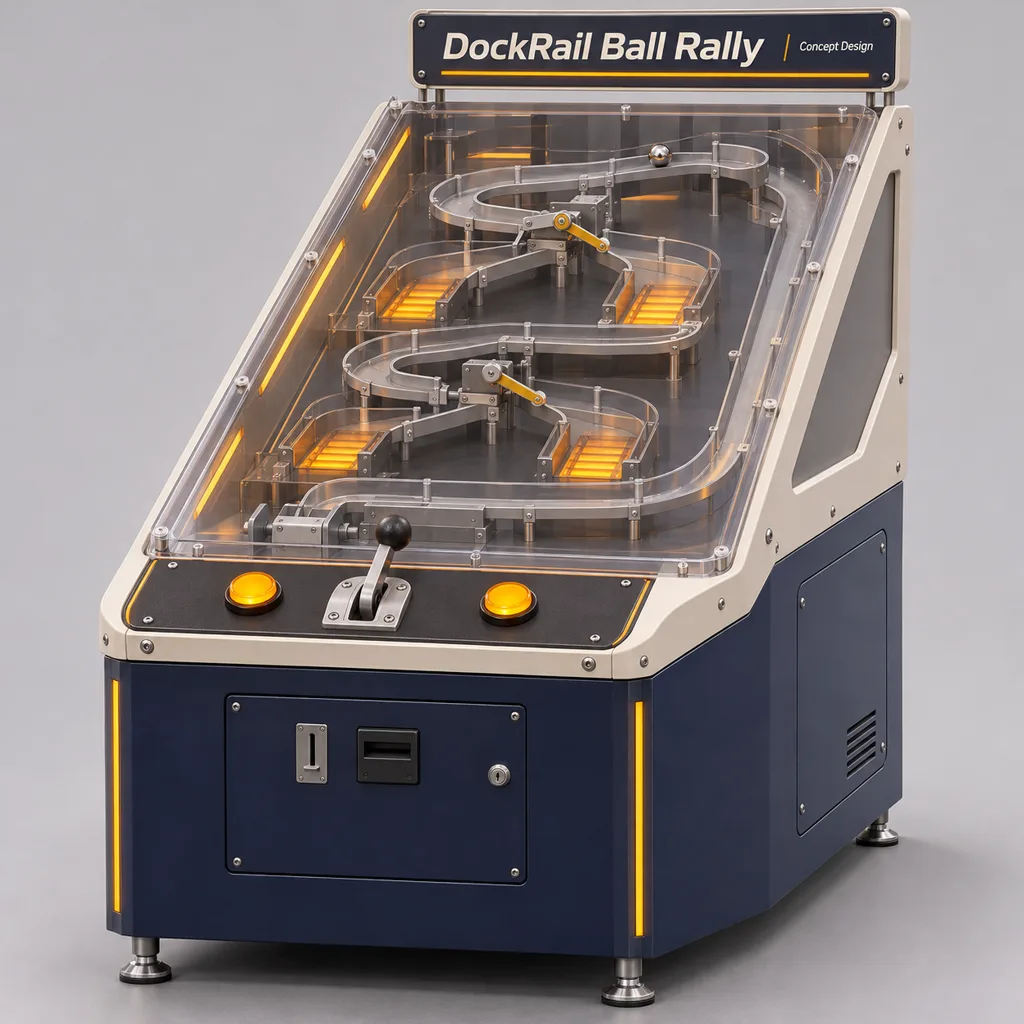
Category: Ball & Pinball Machines
DockRail Ball Rally
Concept design — fully customizable. Contact us to make it real.
- ✓Enclosed playfield cassette proposed to separate from the lower cabinet for delivery and major service.
- ✓Launch lever and two timing buttons control a visible, two-junction ball course.
- ✓Transparent sloping cover keeps the physical rally action in view.
- ✓Proposed return channel and ball-ready sensor coordinate the next round.
- ✓Removable branded header supports delivery-route planning.
A ball-game concept for an overseas FEC opening
Concept design — fully customizable. Contact us to make it real.
DockRail Ball Rally is proposed for an overseas family entertainment center buyer preparing an indoor arcade opening where equipment must travel through a restricted delivery route. The central problem is practical: a visually engaging ball game must reach the arcade floor and remain accessible for maintenance after neighboring machines are installed. This concept addresses that problem with an enclosed playfield cassette that separates from its supporting cabinet for planned transport and service access.
The proposed appearance combines a midnight-blue lower cabinet, warm white side frames and restrained amber lighting. A sloping transparent cover exposes a winding ball course, while a broad front control deck presents one launch lever and two large timing buttons. The cassette joint becomes a deliberate horizontal design detail beneath the playfield. A removable branded header provides venue identity without making a tall, permanently attached sign part of the delivery envelope.
A visible physical rally course
The proposed game uses one reusable, unnumbered play ball traveling through an enclosed course. The player operates a spring-return launch lever, then times two buttons to move guarded diverter gates at separate junctions. Successful timing directs the ball toward illuminated scoring lanes; other routes return it toward the collection channel. A proposed end-of-round display totals lane scores. Prize dispensing is outside this concept's core configuration.
Physical equipment matters because players can watch the actual ball roll, rebound and change routes in response to their actions. Sloped lanes, gate positions and the ball return create the interaction rather than presenting a course only on a screen. Proposed scoring sensors would register lane passages, with the sensor arrangement and scoring rules developed alongside the mechanical layout. Ball material, diameter, launch travel and lane geometry must be matched during engineering; no playing speed or scoring performance is specified here.
A cabinet designed around delivery and service
The proposed playfield cassette contains the course, its transparent cover and ball-return components as one assembly. Captive fasteners, locating guides and keyed electrical connectors are custom design directions intended to support repeatable removal and refitting. The lower cabinet would carry the payment interface and supporting electronics. Removal is intended for trained personnel using a handling method matched to the final assembly weight, rather than routine movement by players or floor staff.
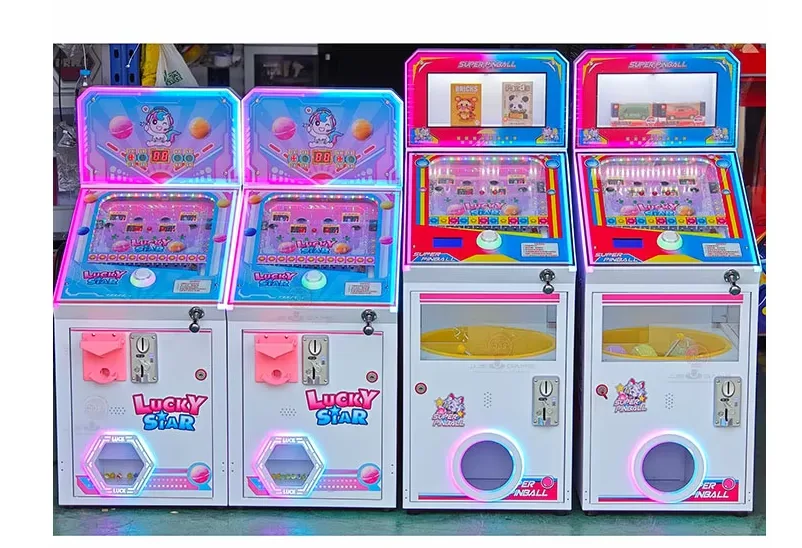
For comparison, Jisun's Super Pinball Machine has a documented 42 × 52 × 112 cm footprint. That existing model may be sufficient when its size suits the venue and the buyer does not need the proposed cassette-based delivery and maintenance arrangement. DockRail Ball Rally instead proposes a separable playfield and a two-junction route-control game. The existing model's dimensions establish a catalog comparison only; they do not define this concept's size or demonstrate its mechanism.
How venue staff prepare, run and reset it
Before opening, staff would inspect the transparent cover and access locks, check that the ball is present, and run a service cycle to observe gate movement, scoring and return travel. During play, the cabinet would accept the configured credit input, enable the launch lever and register the selected scoring route. At the end of the round, the proposed return channel would collect the ball and present it to the launch position. A ball-ready sensor is proposed to prevent another credit from starting a round before the ball has returned.
If the ball stops on the course, staff would place the machine in service mode and isolate power before accessing moving parts. Routine inspection should use accessible service panels; removing the full cassette is reserved for work that requires it. Final access locations depend on the venue's available clearance and maintenance arrangements.
Define the configuration and shipping plan
Jisun needs the buyer's delivery-route measurements, usable floor area, audience profile, preferred round structure, payment interface and destination electrical supply. Custom options include lane layout, gate timing windows, cabinet separation points, header shape and branding. Packed dimensions, assembly weights, electrical load and handling provisions remain engineering outputs for the selected design. International shipping planning also needs the destination, unloading facilities and local assembly arrangements.
Production usually takes 7-15 working days after deposit and final specification confirmation. Shipping time is additional; the final schedule is confirmed in the quotation. Get a Quote with your venue layout and delivery route to develop DockRail Ball Rally for your project.
What Should Be Confirmed Before Engineering?
Who This Concept Is For
- Overseas FEC operator preparing an indoor arcade opening with restricted delivery access
- FEC project distributor coordinating international freight and local equipment assembly
Configuration Directions
- Custom lane slopes, junction positions and scoring routes matched to the selected ball
- Optional adjustment of gate timing windows and round structure
- Custom cassette separation points and locating-guide arrangement
- Optional removable header shapes and venue-branded graphics
- Coin, token or compatible card-reader interface options
- Custom service-panel locations matched to maintenance clearance
- Destination-specific voltage, frequency and plug configuration
Operator and Site Requirements
- Confirm the full delivery route, including doors, turns, lifts and unloading access.
- Provide floor space for players and the selected service-access arrangement.
- Assign trained personnel and suitable handling equipment for cassette removal.
- Inspect ball travel, gate movement, locks and scoring before daily operation.
- Isolate power before accessing moving parts or clearing an internal obstruction.
Inputs We Need From the Buyer
- Destination country, delivery address and unloading facilities
- Delivery-route measurements and venue floor plan
- Intended player age range and control-height preferences
- Preferred round structure and scoring routes
- Preferred ball diameter and material, or permission for Jisun to propose a matched ball
- Payment-system make, interface and credit requirements
- Available voltage, frequency and plug type
- Brand artwork and local maintenance or assembly arrangements
Existing Equipment to Compare
These photos and demonstrations show the existing models cited above. They do not show a completed version of this concept; each model keeps its own specifications.
Customization Questions
- Would floor staff remove the DockRail cassette after each operating day?
- No. The cassette is proposed for planned transport and major service. Daily inspection would use the transparent cover and accessible service panels; removal requires trained personnel and a handling method matched to its final weight.
- How do the two junction buttons affect the ball?
- Each button would move a guarded diverter gate at a separate course junction. The player's timing directs the physical ball toward different scoring lanes.
- What would stop a new round while the ball is still returning?
- A ball-ready sensor is proposed to hold the next round until the return channel has presented the ball at the launch position. Its arrangement must be developed with the final course.
- Which access measurements determine the cabinet separation points?
- Jisun needs door openings, corridor turns, lift dimensions and unloading access, together with the venue layout. These inputs guide the proposed cassette, lower cabinet and removable header arrangement.