Concept / Customizable Design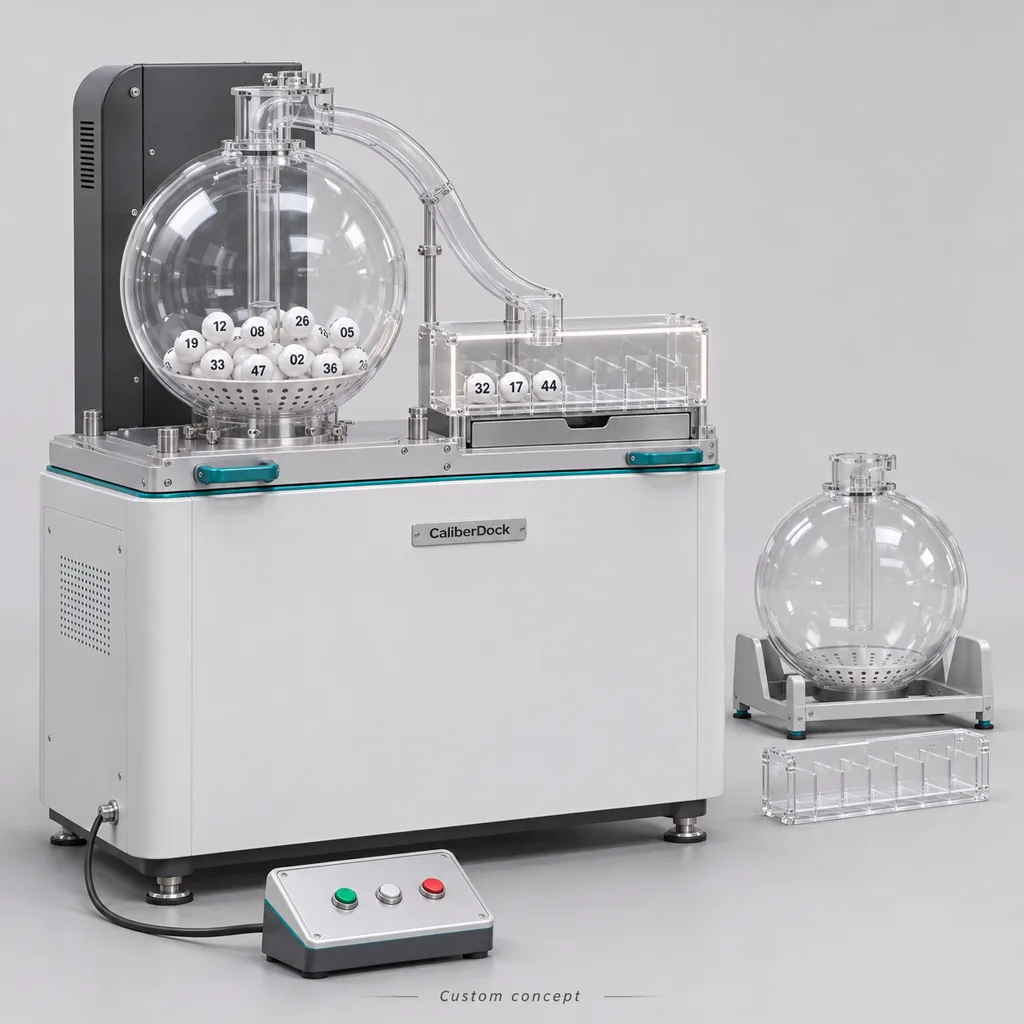
Category: Lottery Ball & Draw Machines
CaliberDock Lottery Draw Station
Concept design — fully customizable. Contact us to make it real.
- ✓Proposed matched modules combine chamber, air distributor, selection throat and transfer guide.
- ✓Matching rack inserts retain common-pool selections outside the chamber in draw order.
- ✓Teal handling points and module identification support planned changes between programs.
- ✓Side module access and a rear service spine shape the studio installation layout.
- ✓Optional separate wired console keeps process controls away from the ball presentation area.
One studio, different ball-set requirements
CaliberDock Lottery Draw Station is a custom concept for a lottery operator equipping a permanent indoor draw studio. Its starting problem is ball size compatibility: a studio may plan different numbered-ball programs, but changing ball diameter or construction affects more than the loading opening. The mixing chamber, selection throat, transfer path and result holder must work together with the selected ball set.
Concept design — fully customizable. Contact us to make it real.
The proposed station gives the operator a physical, visible draw process while making planned configuration changes easier to organize. Numbered balls mix inside a transparent chamber, and selected balls remain visible in a separate result rack. This concept uses one common pool, with selected balls retained outside that pool until the round ends. It does not produce independent digit positions from separate chambers, and its ball path is intended for numbered balls rather than paper raffle tickets.
A matched draw module instead of a universal opening
The proposed cabinet has a broad matte-white lower body, a charcoal service spine and a clear upper enclosure. A removable draw module would combine the transparent mixing chamber, air distributor, single-ball selection throat and transfer guide on one locating frame. A matching result-rack insert would complete the ball path. Teal handles and corresponding identification plates would help staff recognize the components belonging to the same configuration.
As a custom design direction, one module could be engineered around a specified 40 mm ball set, while a separate module could be developed for a specified 50 mm set. These are proposed alternatives, not a claim that either size can be substituted into one unchanged mechanism. Ball mass, material, diameter tolerance, surface finish and pool quantity would determine chamber geometry and airflow requirements. Changing between hollow and solid balls would also require configuration assessment, even at the same nominal diameter.
The intended distinction is a complete matched module that staff change between programs, rather than loose adapters inserted into an otherwise unchanged machine. A proposed mechanical locating system, module identification input and control lockout would prevent normal draw operation until the installed configuration is acknowledged. Their implementation and response to an incorrect or incomplete installation would form part of the agreed functional checks.
Prepare, draw, retain and reset
Before a session, venue staff would isolate the equipment, install the specified module and matching rack insert, and check their retention points. Staff would then reconcile the numbered ball inventory, load the agreed pool and select its corresponding operating recipe. A rehearsal would check ball movement, single-ball transfer and result visibility before the scheduled program.
During the round, the operator would start mixing and initiate selections from an optional separate wired console. Selected balls would travel through the clear guide into individual retaining positions, preserving their draw order and keeping them outside the remaining pool. Console commands would control process steps; they would not select a winning number. Mixing duration, selection sequence and pauses would be specified for the buyer's workflow rather than advertised as a fixed cycle time.
After the results are recorded, staff would stop the mechanism and use a proposed removable result tray to return the retained balls through the loading opening. They would reconcile the full set before another round. Module changes would take place only between completed sessions, with the equipment isolated and all balls removed.
Where an existing machine is sufficient
Jisun's YP800 49-Ball Lotto Machine uses 50 mm balls and has a documented standard 49-ball, 6+1 draw format. For a studio using that ball size and format consistently, the existing model may be sufficient. CaliberDock instead proposes a matched-module architecture for buyers with a defined need to change ball configurations between programs. The YP800 reference describes existing equipment; it does not establish CaliberDock's capacity, module compatibility or operating performance.
Define the installation and custom scope
Cabinet dimensions would follow the selected chamber envelope, result count and module-removal direction. The venue must allow room beside the cabinet for module handling, a suitable storage location for unused modules and access to the service spine. An optional camera mounting rail could frame the retained balls without blocking the loading opening; camera equipment and video connections would be specified separately.
For a quotation, send Jisun the ball count and number range for each program, ball diameter and construction, selections per round, replacement rules, preferred controls, available installation space and destination electrical supply. Existing ball sets can be assessed for a custom configuration, but nominal diameter alone does not establish compatibility. Proposed factory checks would cover the agreed ball sets, module installation, selection and retention sequence, reset procedure and control responses. Production usually takes 7-15 working days after deposit and final specification confirmation. Shipping time is additional; the final schedule is confirmed in the quotation.
Get a Quote for a CaliberDock configuration matched to your studio's ball sets and draw workflow.
What Should Be Confirmed Before Engineering?
Who This Concept Is For
- Lottery operators planning permanent indoor studios with more than one defined ball-set program
- Draw-studio equipment buyers replacing improvised ball-size adapters with a planned changeover system
- Lottery equipment integrators specifying common-pool draws and retained physical results
Configuration Directions
- Separate matched modules proposed for specified 40 mm or 50 mm ball sets
- Chamber geometry and airflow configuration developed for each ball material, mass and pool quantity
- Result-rack insert layout configured for the required selection count
- Mechanical module location, identification input and operating lockout developed as custom functions
- Separate wired operator console as an option
- Optional camera mounting rail with separately specified camera equipment and video connections
- Cabinet finish, branding and module-removal direction configured for the studio
Operator and Site Requirements
- Provide clearance for module removal, handling and service-spine access.
- Provide suitable storage for unused matched modules and rack inserts.
- Isolate equipment and remove all balls before changing modules.
- Reconcile the ball inventory before each session and after resetting the result tray.
- Run a rehearsal with the installed module and its specified ball set before the scheduled program.
Inputs We Need From the Buyer
- Pool quantity and numbered range for each planned program
- Ball diameter, tolerance, material, mass and surface finish for each set
- Selections per round, selection order and replacement rules
- Required mixing sequence, pauses and reset workflow
- Preferred console arrangement and control functions
- Available cabinet space, module-handling clearance and storage location
- Destination voltage, frequency and plug requirements
- Camera framing and video connection requirements if the camera option is requested
Existing Equipment to Compare
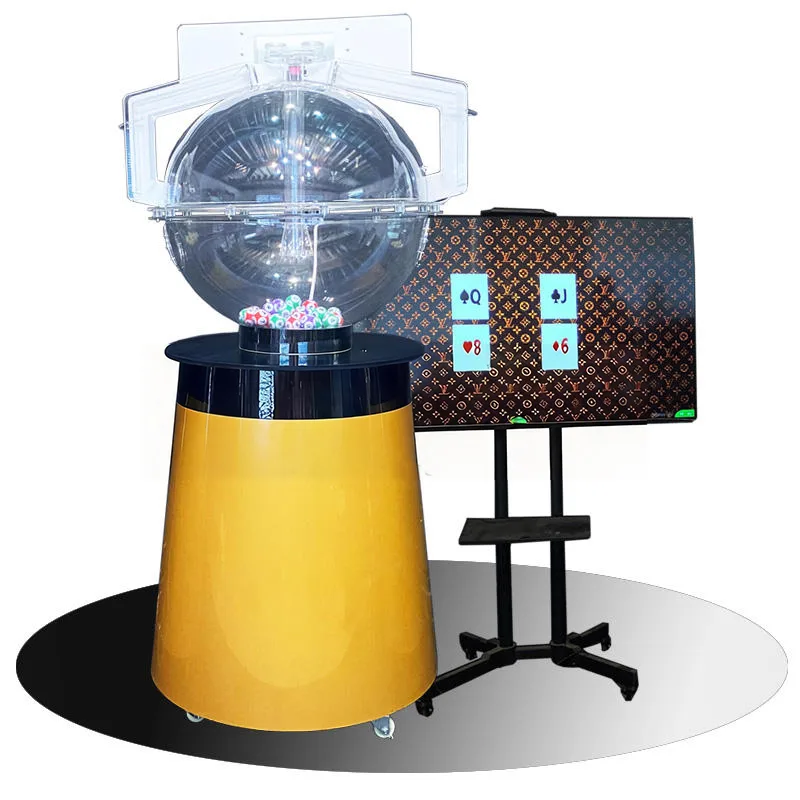
These photos and demonstrations show the existing models cited above. They do not show a completed version of this concept; each model keeps its own specifications.
Customization Questions
- Would CaliberDock use the same draw module for 40 mm and 50 mm balls?
- The concept proposes separate matched modules and result-rack inserts for those ball sets. Chamber geometry, airflow and the complete transfer path would be developed for each configuration; changing the opening alone would not establish compatibility.
- Can staff change a CaliberDock module while balls remain in the chamber?
- Module changes are intended only between completed sessions. Staff would isolate the equipment, remove all balls and then install the matching module and rack insert before inventory checks and a rehearsal.
- How does the CaliberDock rack prevent a selected ball from rejoining the current pool?
- The proposed transfer guide delivers selected balls into separate retaining positions outside the mixing chamber. They remain there in draw order until staff record the results and reset the round using the removable tray.
- What space does the removable-module layout need beyond the cabinet?
- The studio needs clearance in the specified module-removal direction, access to the service spine and suitable storage for unused modules. These requirements determine the installation layout alongside the chamber and result-rack envelope.