Concept / Customizable Design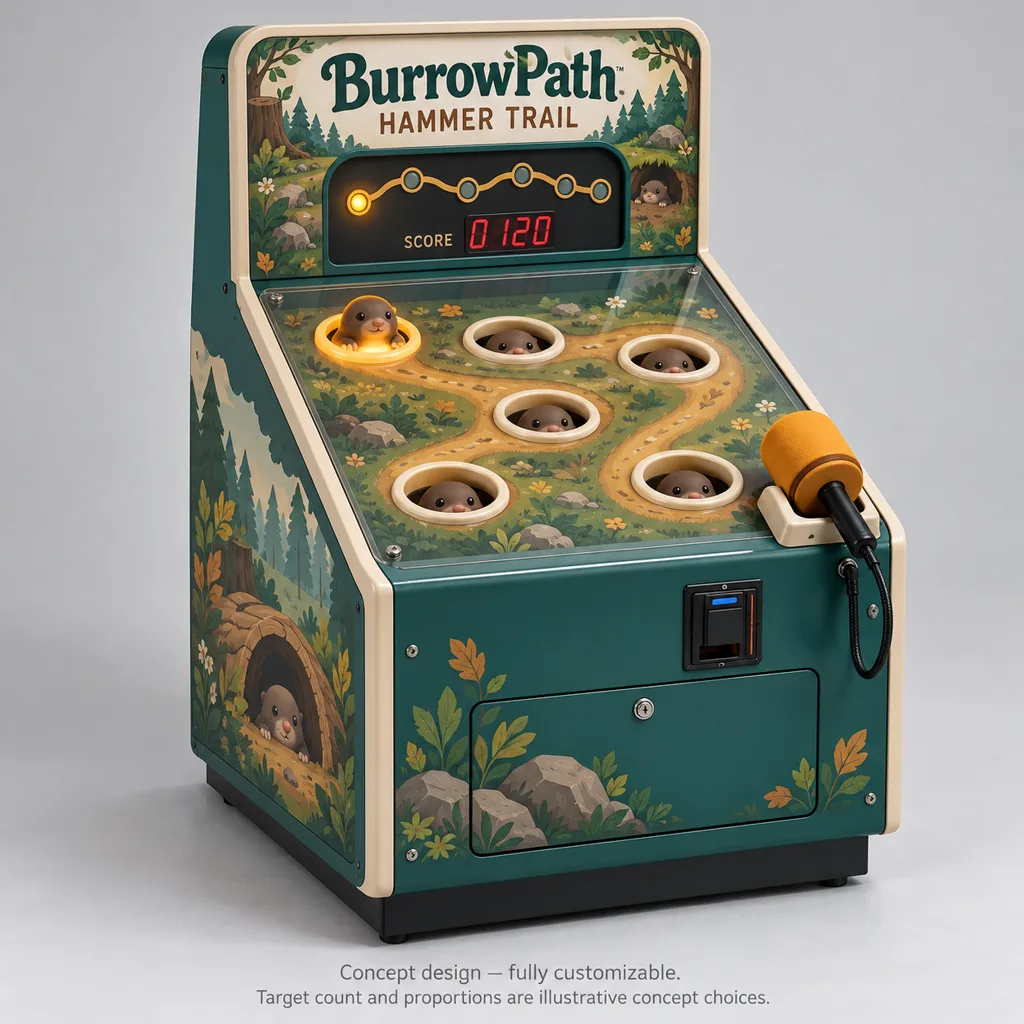
Category: Whack-a-Mole & Hammer Games
BurrowPath Hammer Trail
Concept design — fully customizable. Contact us to make it real.
- ✓An illuminated trail connects physical rising targets into a visible sequence.
- ✓One active target at a time keeps the next strike clear to players and spectators.
- ✓A sloped play deck and upright route display support aisle-side viewing.
- ✓Proposed service mode checks each target's movement and sensor response.
- ✓Optional route-based ticket redemption or score-only gameplay.
A visible hammer challenge for mall arcade floors
Concept design — fully customizable. Contact us to make it real.
BurrowPath Hammer Trail is a proposed single-player hammer game for a shopping mall arcade operator who needs visitors to understand a skill challenge while watching from the aisle. Its central problem is making the player's objective visible: instead of simply striking whichever mole appears, the player follows an illuminated trail across a field of physical rising targets. Spectators can see where the trail begins, which target comes next and how far the player has progressed.
The proposed cabinet has a gently sloped play deck, rounded front corners and a narrow upright scoreboard. A winding illuminated path connects the target openings beneath a protective transparent surface layer. Teal cabinet panels, warm amber route lighting and illustrated burrow entrances give the machine a recognizable identity without requiring a large scenic enclosure. Cabinet proportions, deck reach and scoreboard height are custom design directions to develop around the intended players and venue layout.
Physical targets with a route-following objective
The proposed mechanism uses individually actuated, soft-topped mole targets that rise through guarded deck openings. A padded tethered hammer provides the physical striking action. The active target's surrounding light identifies the next step along the trail; a registered strike advances the route. Physical equipment matters here because reaching between targets, handling the hammer and timing contact with a rising target create the challenge. A screen alone would not provide that movement or impact interaction.
In the proposed standard game sequence, one target is active at a time. A missed target can pause route progress or consume part of the round, depending on the selected rule set. Engineering would define target travel, strike sensing, response timing and protection against unintended repeated contacts. These are development requirements, not measured performance claims. Optional redemption would translate the completed route and score into a venue-defined ticket award; the scoring rules and compatible ticket interface would be agreed separately.
Preparation, daily operation and reset
Before opening, venue staff would inspect the hammer padding and tether, check that target openings are unobstructed, and run a proposed service sequence that raises each target and displays its sensor response. Staff would then select the agreed game duration, route difficulty and payment or free-play mode through a protected operator menu. If a physical ticket dispenser is specified, staff would also load tickets and check its feed path.
During play, the cabinet would show the current route position and remaining round time. At the end, the proposed reset sequence retracts the targets, clears the active route and returns the display to its introductory demonstration. A detected target fault should inhibit the next game and identify the affected position for staff attention. Service access, fault detection and reset behavior require engineering development. The venue must confirm cleaning access, maintenance staffing, surrounding circulation space and acceptable sound levels before the cabinet layout is finalized.
When a classic machine is sufficient
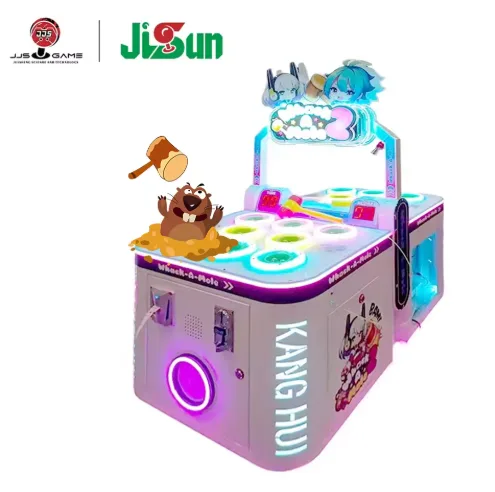
Compare this proposal with Jisun's existing Whack-a-Mole Machine, JISUN-MOLE-001, which provides classic hammer gameplay and supports cabinet graphics and branding customization. That existing model is sufficient when the venue wants an easy-to-understand reaction game with its own visual identity. BurrowPath instead proposes a linked target sequence, visible route progression and route-based scoring. Those changes require a different control sequence and play-deck development; the existing model's specifications do not establish this concept's dimensions or behavior.
Define the configuration with Jisun
Custom options include a shorter introductory route, branching routes for repeat play, alternate cabinet graphics and a score-only format without ticket dispensing. Branching routes would still present one active target at a time, keeping the objective readable. Payment hardware and redemption connections are optional integrations whose interfaces must be specified. Destination voltage, plug type and electrical requirements would be established for the proposed build rather than copied from another model.
For a quotation, send the intended player age range, available installation area, access-route restrictions, preferred round structure, payment system and redemption requirements. Engineering also needs the desired target arrangement, reach expectations and service-access direction. Customize BurrowPath Hammer Trail with Jisun or Get a Quote for a configuration shaped around your arcade floor.
What Should Be Confirmed Before Engineering?
Who This Concept Is For
- Shopping mall arcade operators seeking a spectator-readable hammer game
- Family entertainment center buyers planning a reaction-game area
- Arcade groups developing a consistent branded skill-game format
Configuration Directions
- Custom target arrangement and route length, subject to reach and mechanism development
- Optional introductory or branching routes with one active target at a time
- Adjustable round structure and missed-target rules
- Optional score-only play or ticket redemption integration
- Optional coin, card-system or free-play controls with specified interfaces
- Custom cabinet graphics, route colors and burrow illustrations
- Optional front or rear service access, subject to cabinet engineering
Operator and Site Requirements
- Confirm player clearance, spectator circulation and service-access space.
- Provide destination electrical supply details for configuration.
- Assign staff to inspect the hammer, tether and target openings before operation.
- Confirm acceptable sound levels and cleaning procedures for the venue.
- Provide ticket loading and feed-path access if physical redemption is specified.
Inputs We Need From the Buyer
- Intended player age range and reach expectations
- Available installation area and delivery-access restrictions
- Preferred target arrangement and route complexity
- Round duration preference and missed-target behavior
- Payment system make, interface and operating mode
- Score-only or redemption requirements and ticket-system interface
- Destination electrical supply and plug requirements
- Brand artwork and preferred maintenance-access direction
Existing Equipment to Compare
These photos and demonstrations show the existing models cited above. They do not show a completed version of this concept; each model keeps its own specifications.
Customization Questions
- How would players identify the next BurrowPath target?
- The proposed design illuminates the active target's surrounding light along the connected trail. Only one target is active at a time, including in the optional branching-route format.
- What happens when a player misses a step on the trail?
- The selected rule set could pause route progress or consume part of the round. Jisun needs the preferred missed-target behavior before developing the control sequence.
- How would staff check a target that fails to respond?
- A proposed service sequence would raise each target and display its sensor response. The intended fault behavior is to inhibit the next game and identify the affected position; those functions require engineering development.
- Can BurrowPath operate without dispensing tickets?
- Yes, a score-only configuration is a proposed option. Ticket redemption would require an agreed award rule and a specified compatible interface.